Riel Hilario, "Gazing into the horizon while it gazes back at you", carved and polychromed friutwood, 70x24x20 cm
When sculptor Riel Hilario sits before a chunk of wood, he has no preconceived forms in his head. Like a shaman, he lets the wood guide him, allowing it to tell him what to do. On occasion, he even lets his dreams dictate the directions of his hands. What he consciously aspires for is the creation of contemporary sculpture using the woodcarving traditions he grew up with. In this exhibit of new works at The Drawing Room, Riel taps into his Ilocano heritage to once again bring us his rebultos, art that is in the round, derived “from the block”. Continue reading →
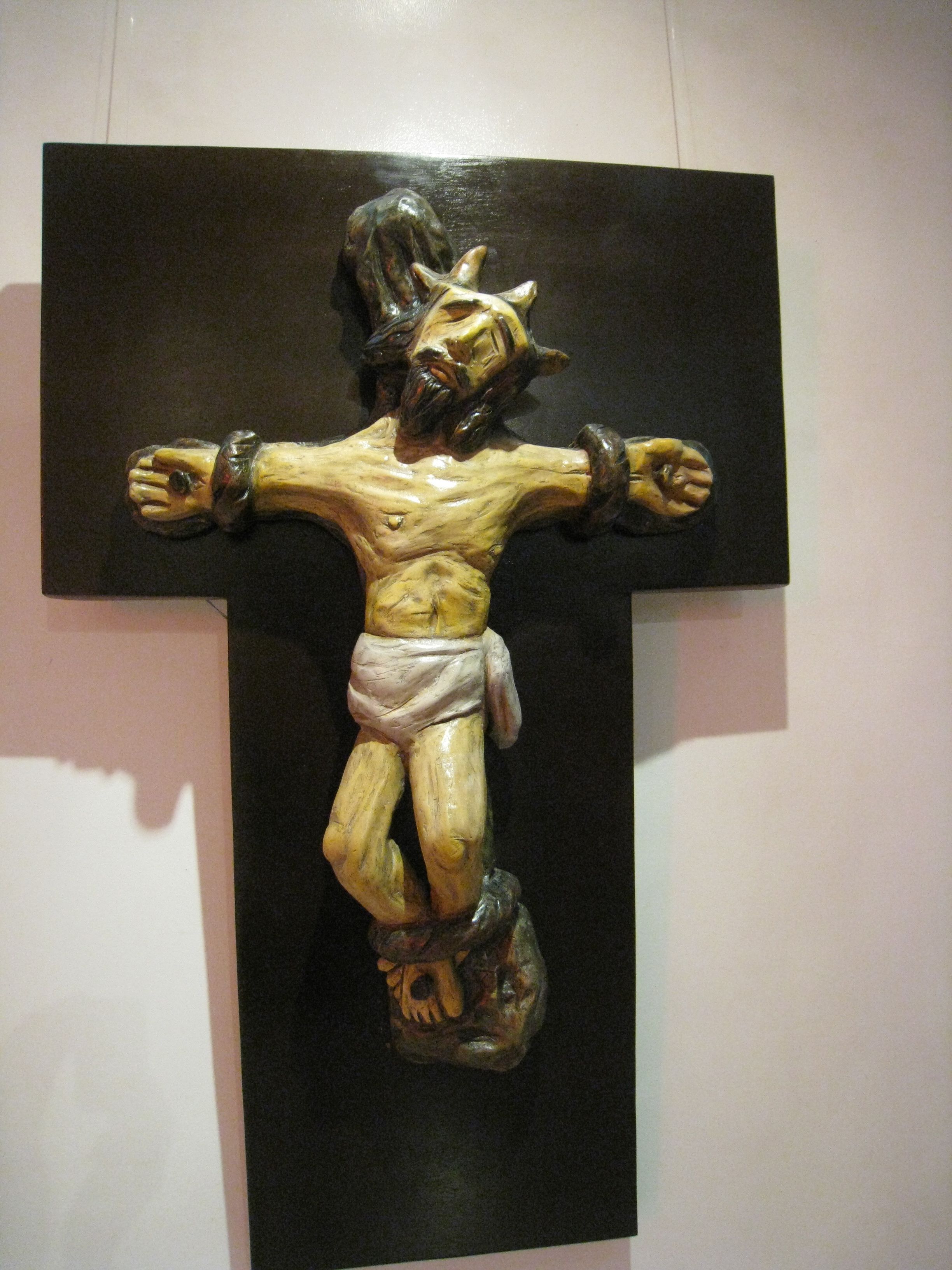
Julie Lluch, "Aba's Yellow Christ", terracotta and acrylic
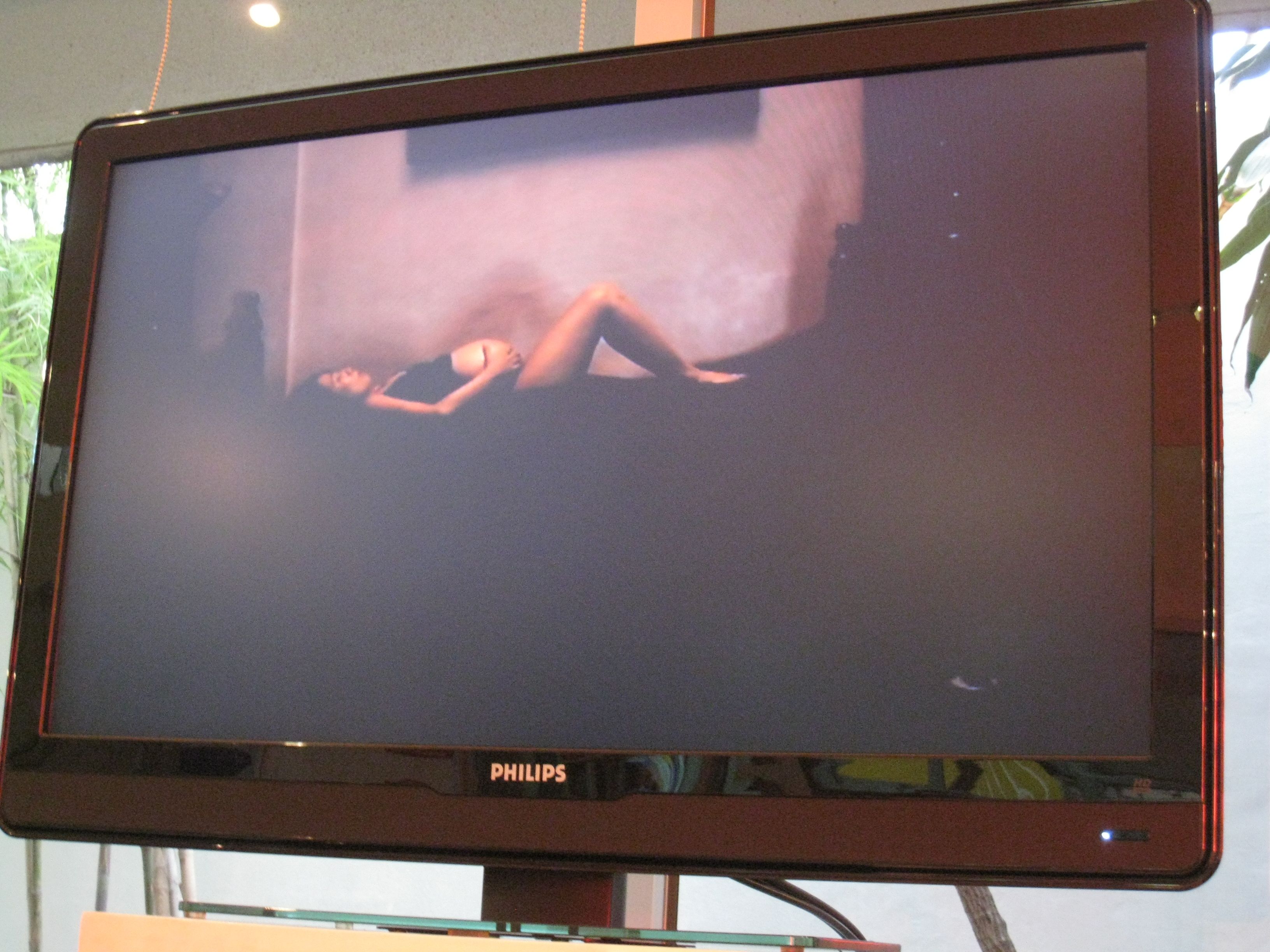
Being with family means having the freedom to relax, get goofy, be yourself. It implies the comfort to do as one pleases. Where else would Kiri Dalena, artist and activist who takes us to the scenes of massacre and murder, show her irreverent side other than with her family? Or will her sister Sari share a self-portrait that unabashedly glories in her protruding pregnant belly? Home Works, at the AFM Total Gallery, captures the
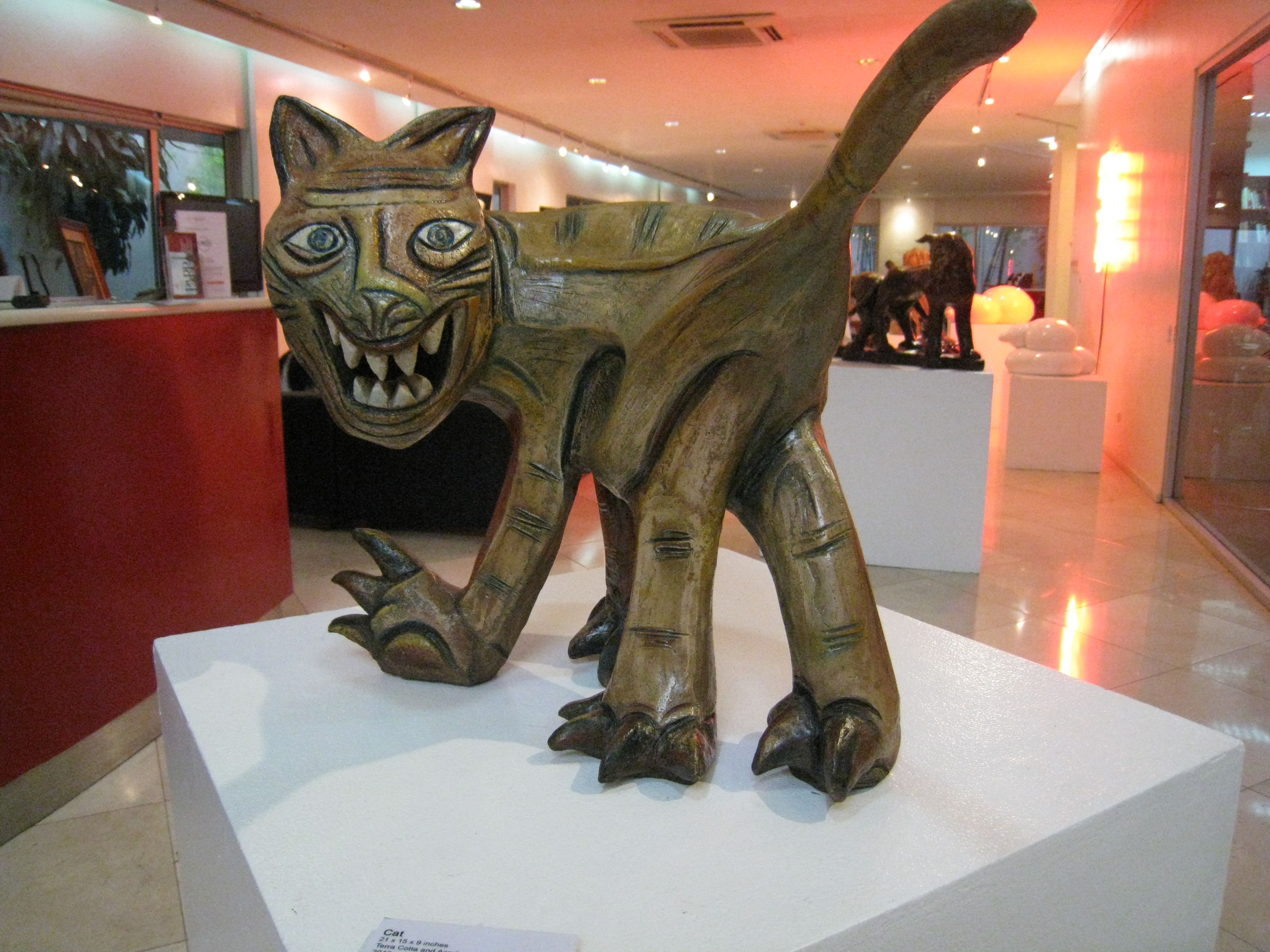
Julie Lluch, "Cat", terracotta and acrylic
casual, humorous, and playful atmosphere of a family get together. The group exhibit presents works by the celebrated sculptor, Julie Lluch, and her three equally-talented daughters.
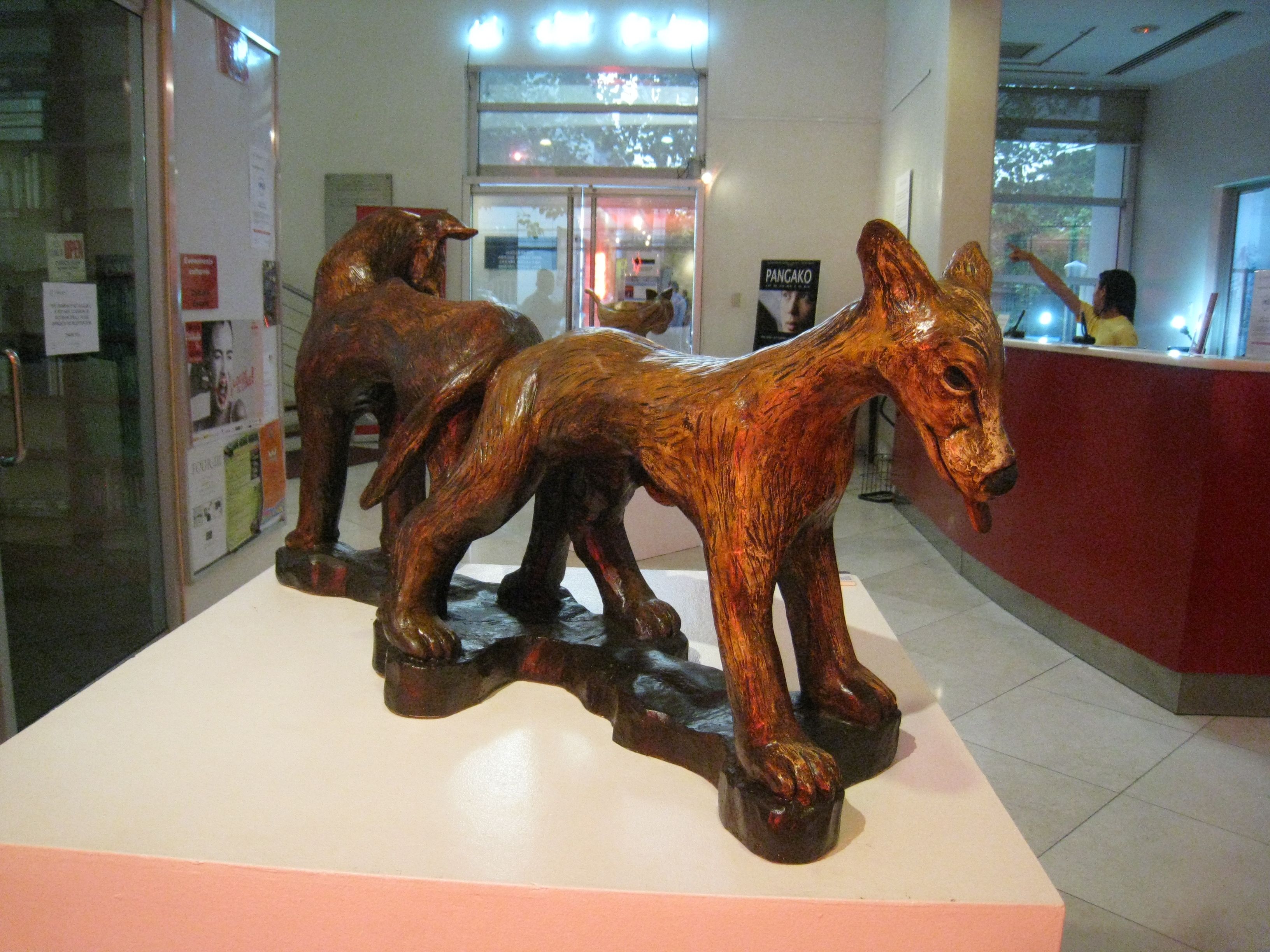
Aba Lluch Dalena, "Buhay Aso", terracotta and acrylic
Julie brings out intimate pieces, clay and marble renditions of domestic animals and decorative objects that one encounters within the sphere of one’s home. As we enter the main exhibit area, her sculpture of a startled cat greets us. Produced in what has now been recognized as a Julie Lluch trademark, she depicts the animal with its hackles raised, its teeth bared, half snarling, half surprised. The cat’s comical expression in the many versions of this piece never fails to get a laugh out of me.
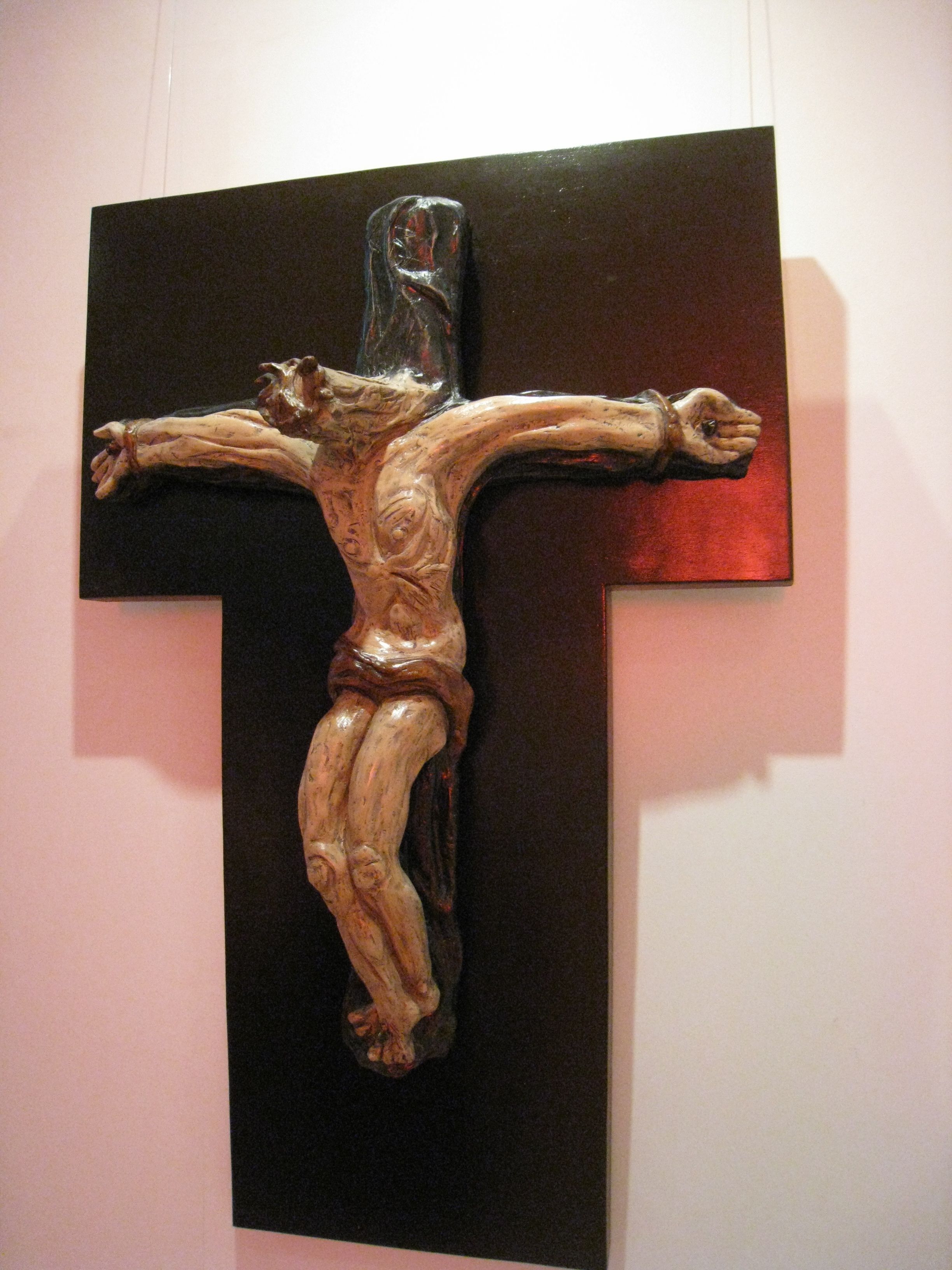
Julie Lluch, "Crucifix After Aba", terracotta and acrylic
Nearby, as a counterpoint to Cat, we see the first of Aba Lluch Dalena’s works: two dogs joined together, caught in flagrante, seemingly oblivious to the humans in their vicinity—just as they would be in real life. Three versions of a crucifix adorn one of the gallery’s walls. Aba’s Yellow Christ is the only one of the three where Julie completes the details of Christ’s head and face. While I have seen several of Julie’s crucifixes, I have not seen any of these particular ones before.
Aba’s sculpture has been set amongst her mother’s work.
Aba Lluch Dalena, "Home Works 2 (Daddy in Pakil, Laguna)", terracotta and acrylic
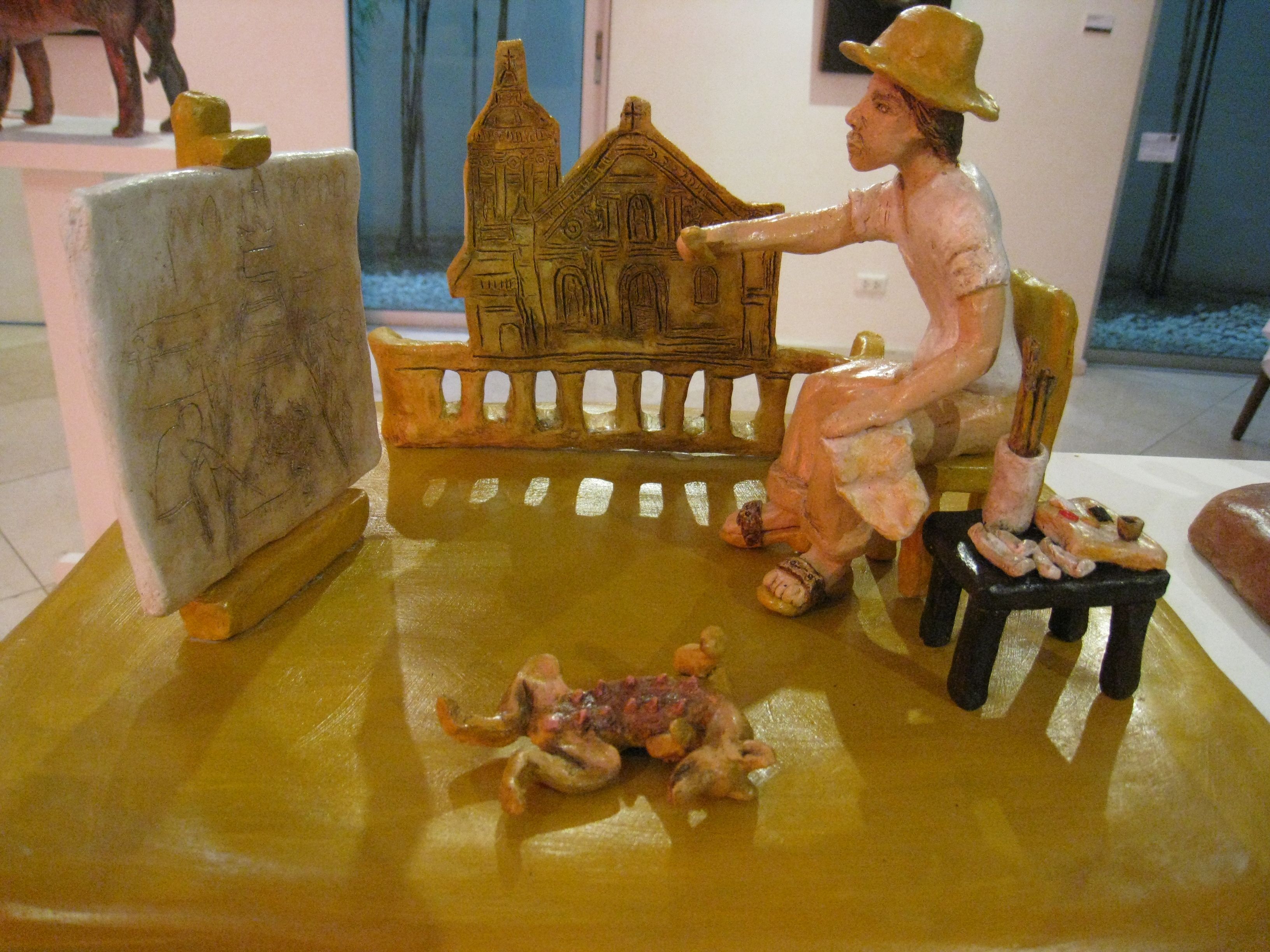
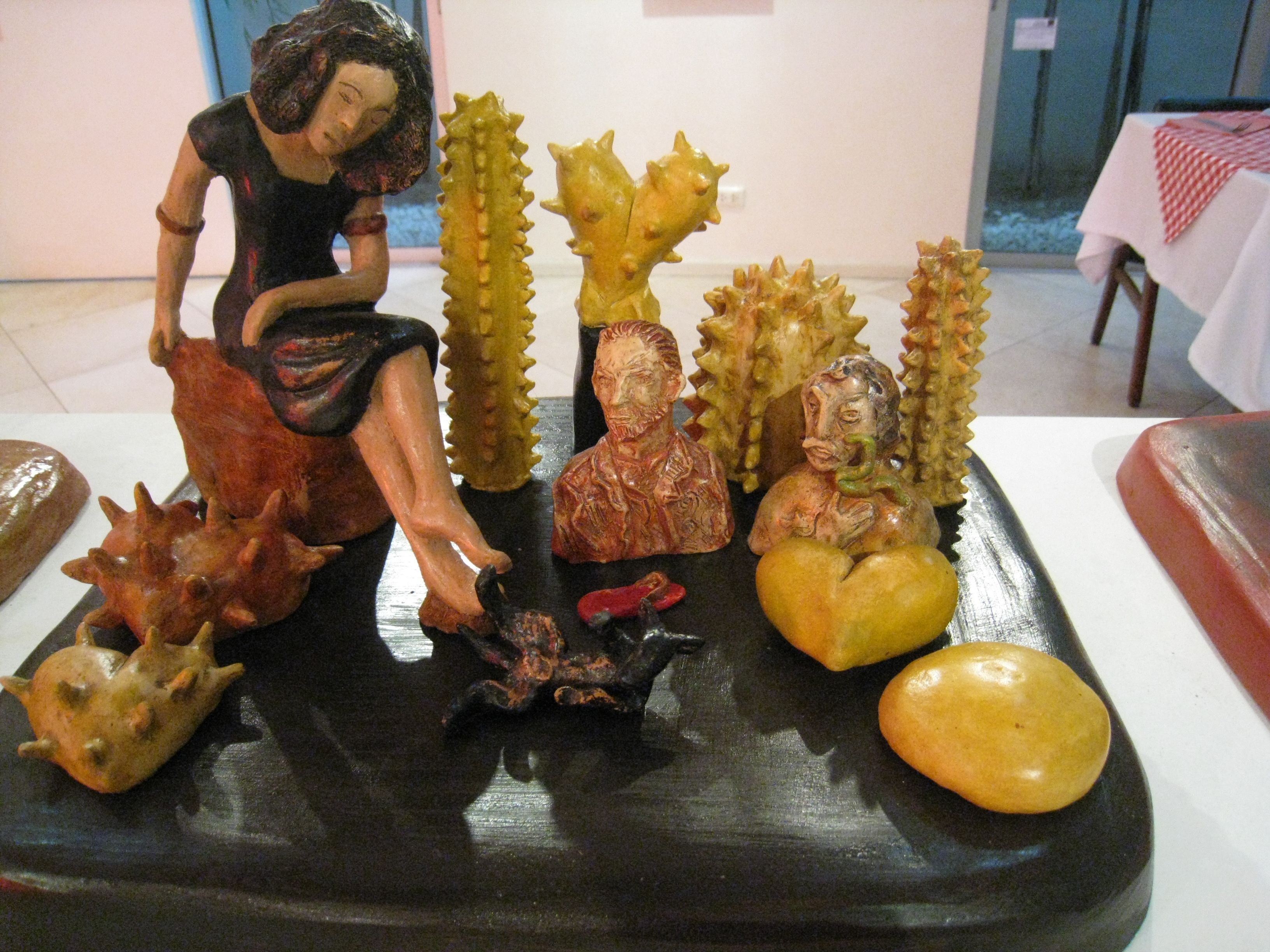
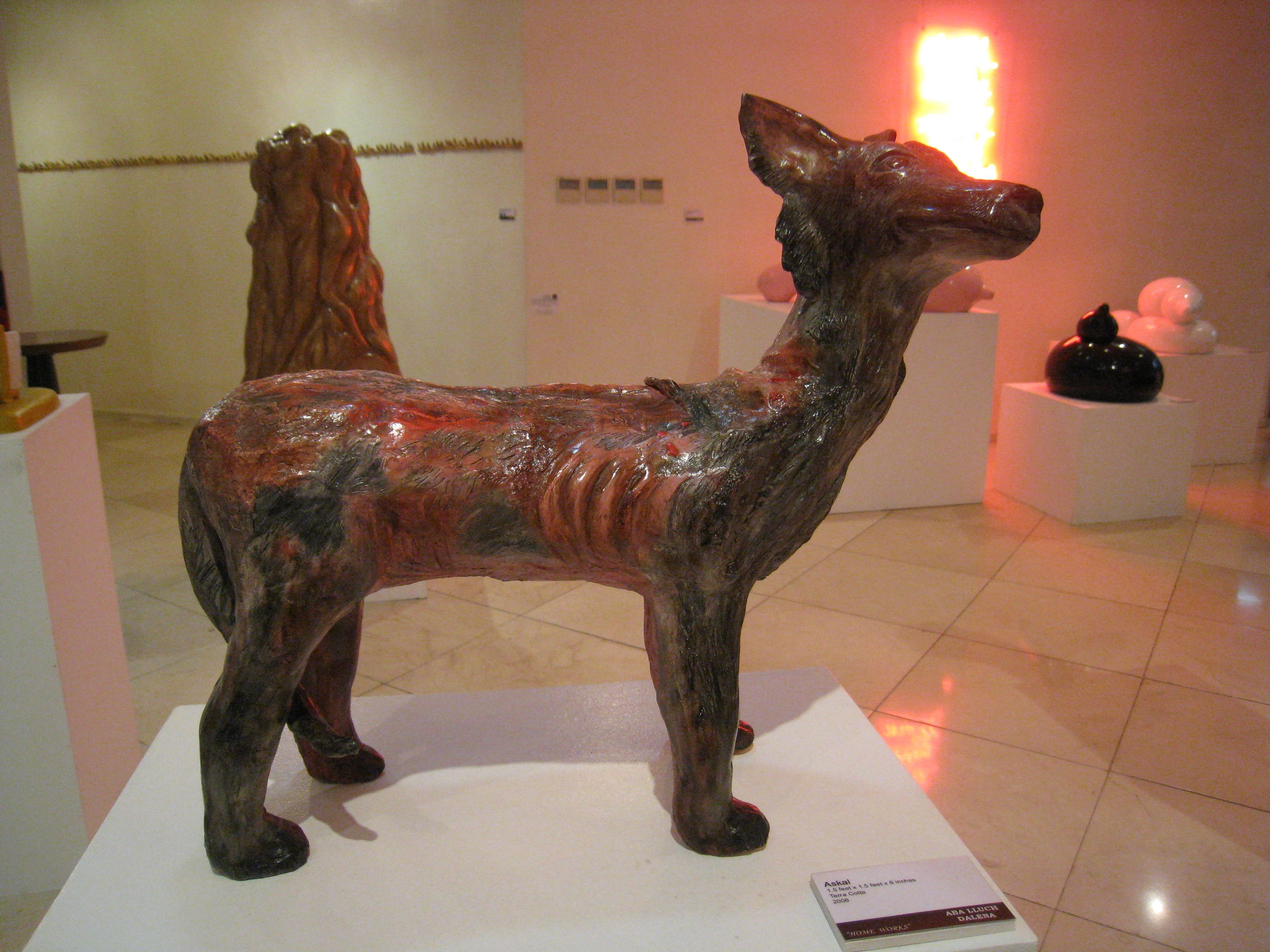
Along with Askal, another stray pup, and Palaka, a giant green toad, she created four miniature tableaux full of wonderful detail.
Home Works 2 (Daddy in Pakil, Laguna) shows their father at work, the great Danny Dalena seated before a canvas. It includes a small facade of Pakil’s famous cathedral, echoing
Aba Lluch Dalena, "Home Works 1 (Mommy and her Cacti Heart Sculptures)", terracotta and acrylic
the actual view from the Dalena ancestral home. Home Works 1(Mommy and Her Cacti Heart Sculptures) is my favorite. It depicts Julie amidst many of her most recognizable work: the busts of Van Gogh and Gauguin, spiky cacti, her clay hearts. Both pieces include playful dogs wiggling on the floor.
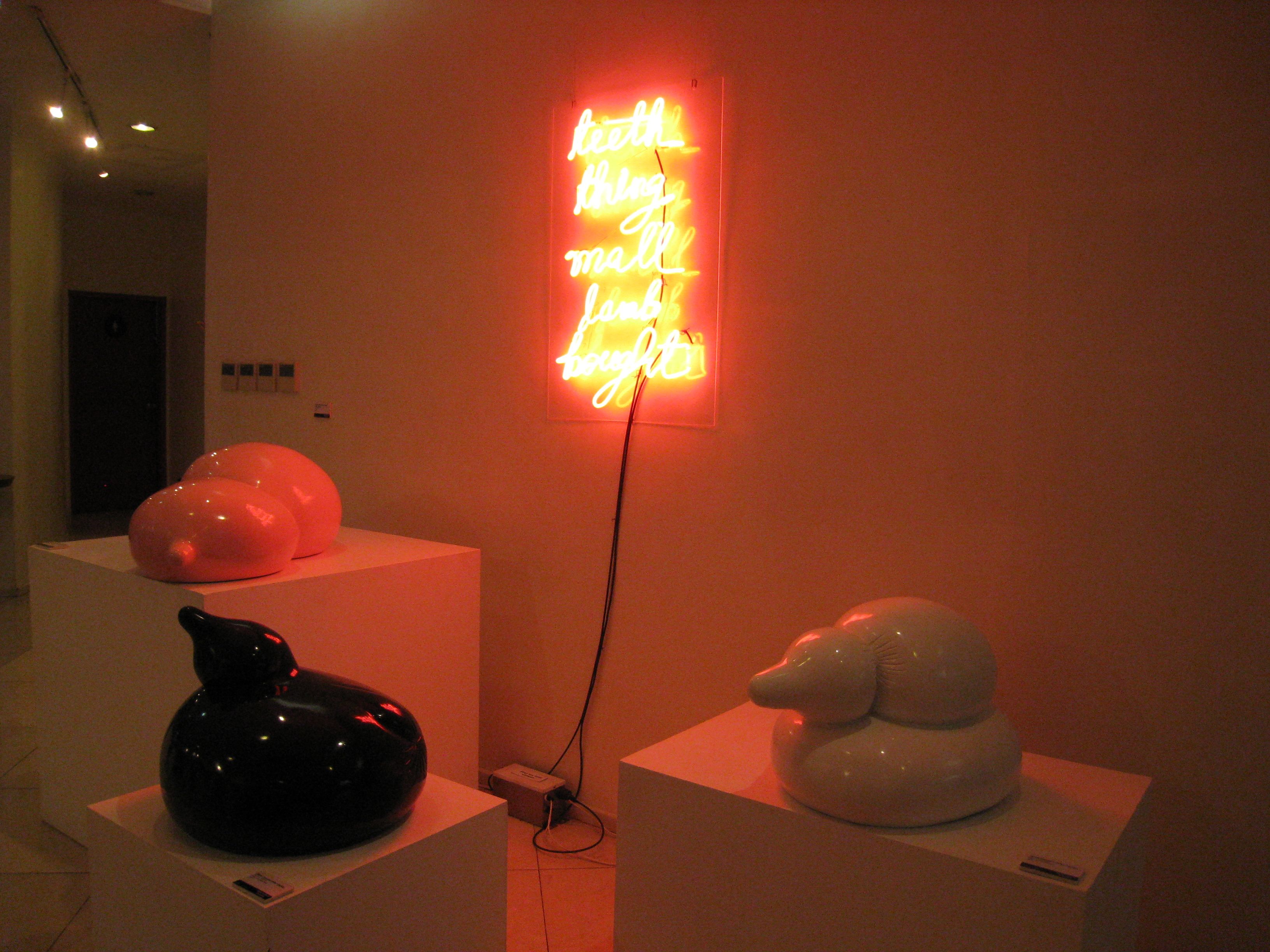
Kiri Dalena, "Five Words To Read Aloud (After Daddy)", neon
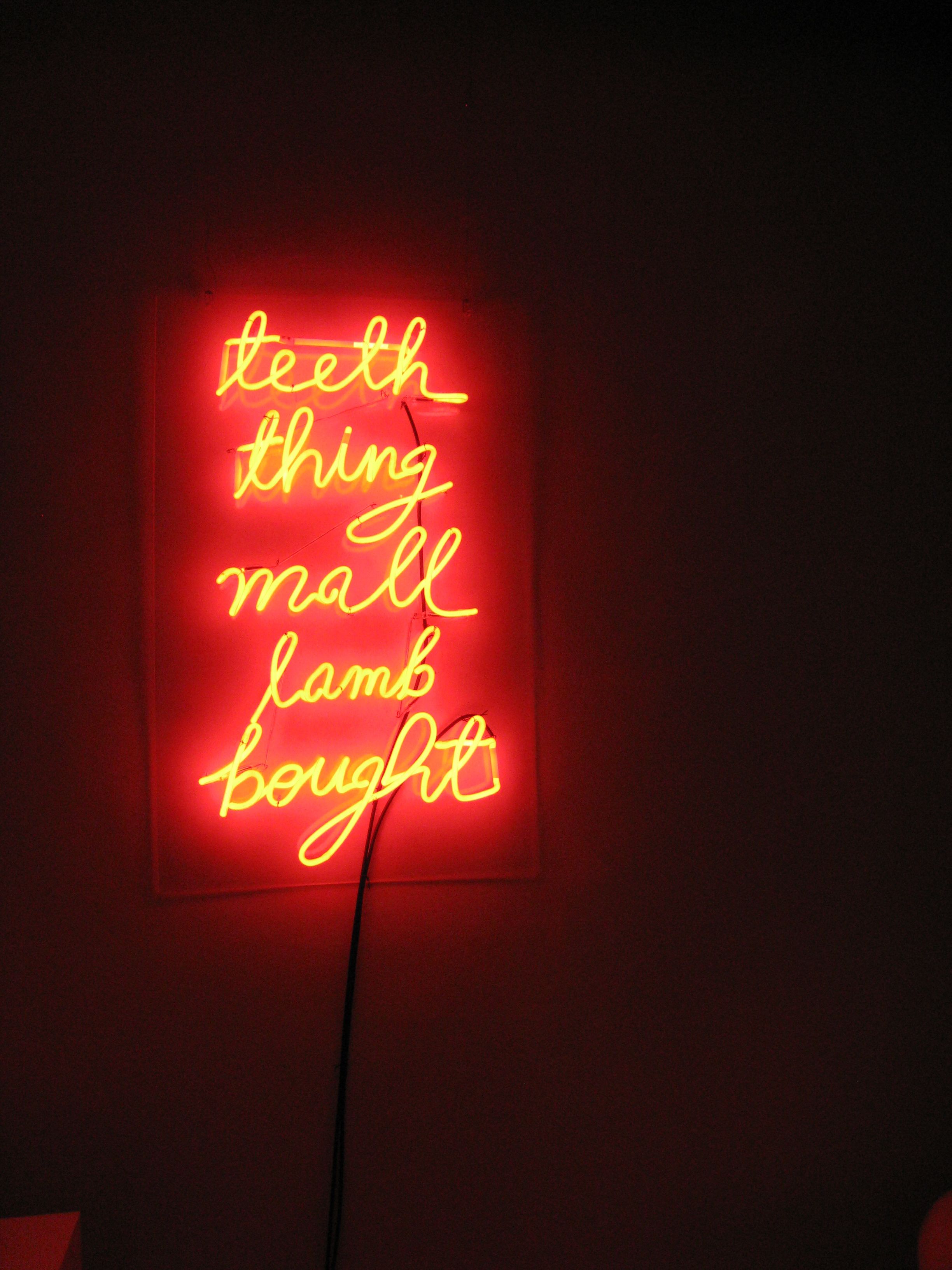
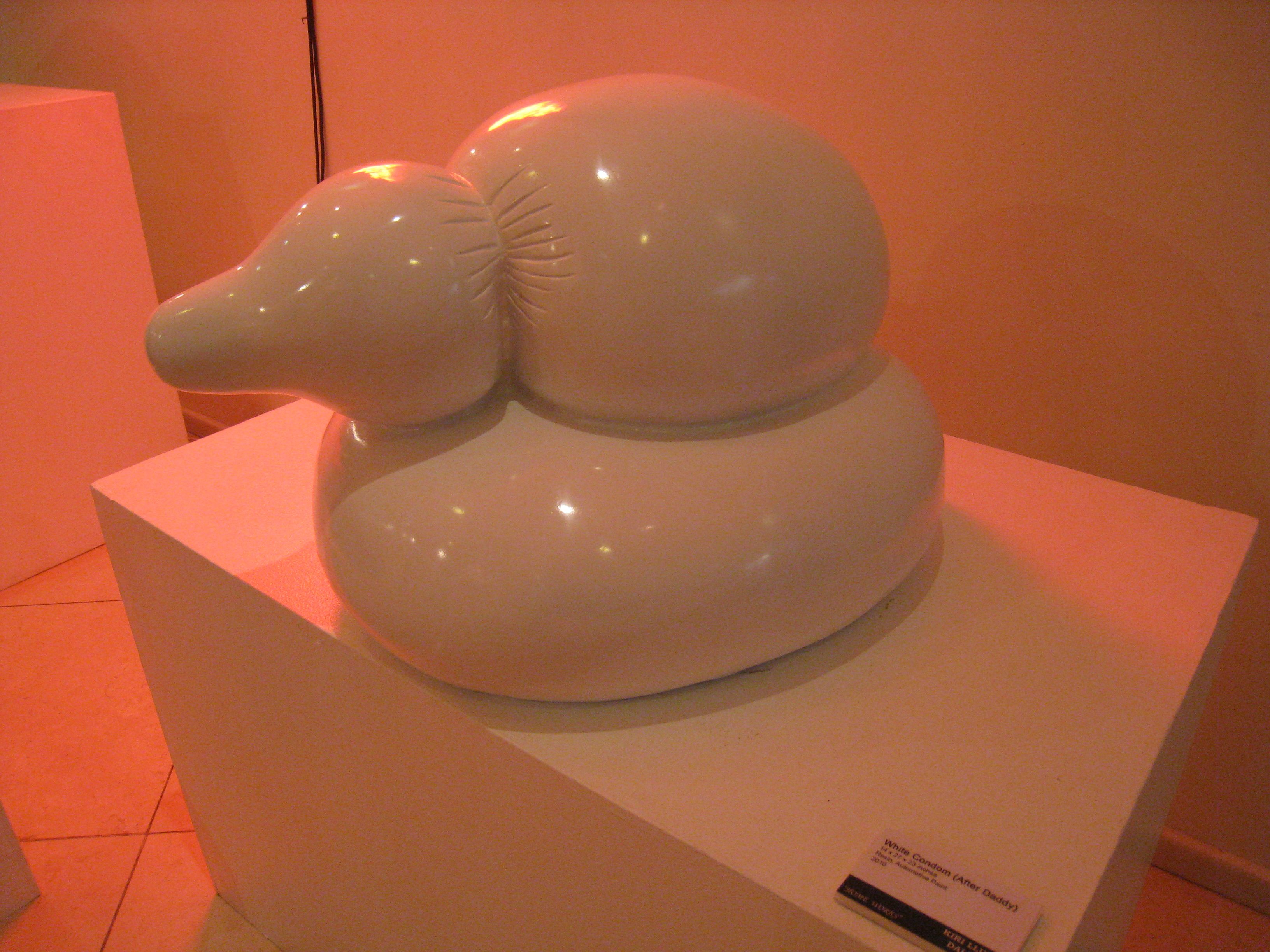
I thought Kiri’s work the most surprising of all. Her pieces in this show depart completely from the socio-political commentaries we have come to associate with her. She cast three larger than life blown up condoms in resin, painted in baby pink, black, and white. The three have been placed before a neon sign with the
Kiri Dalena, "White Condom (After Daddy)", resin and automotive paint
words teeth, thing, mall, lamb, bought. If we do as the title suggests, Five Words To Be Read Aloud (After Daddy), we realize why her condoms have such odd shapes!
Exhibit installation of Kiri's work
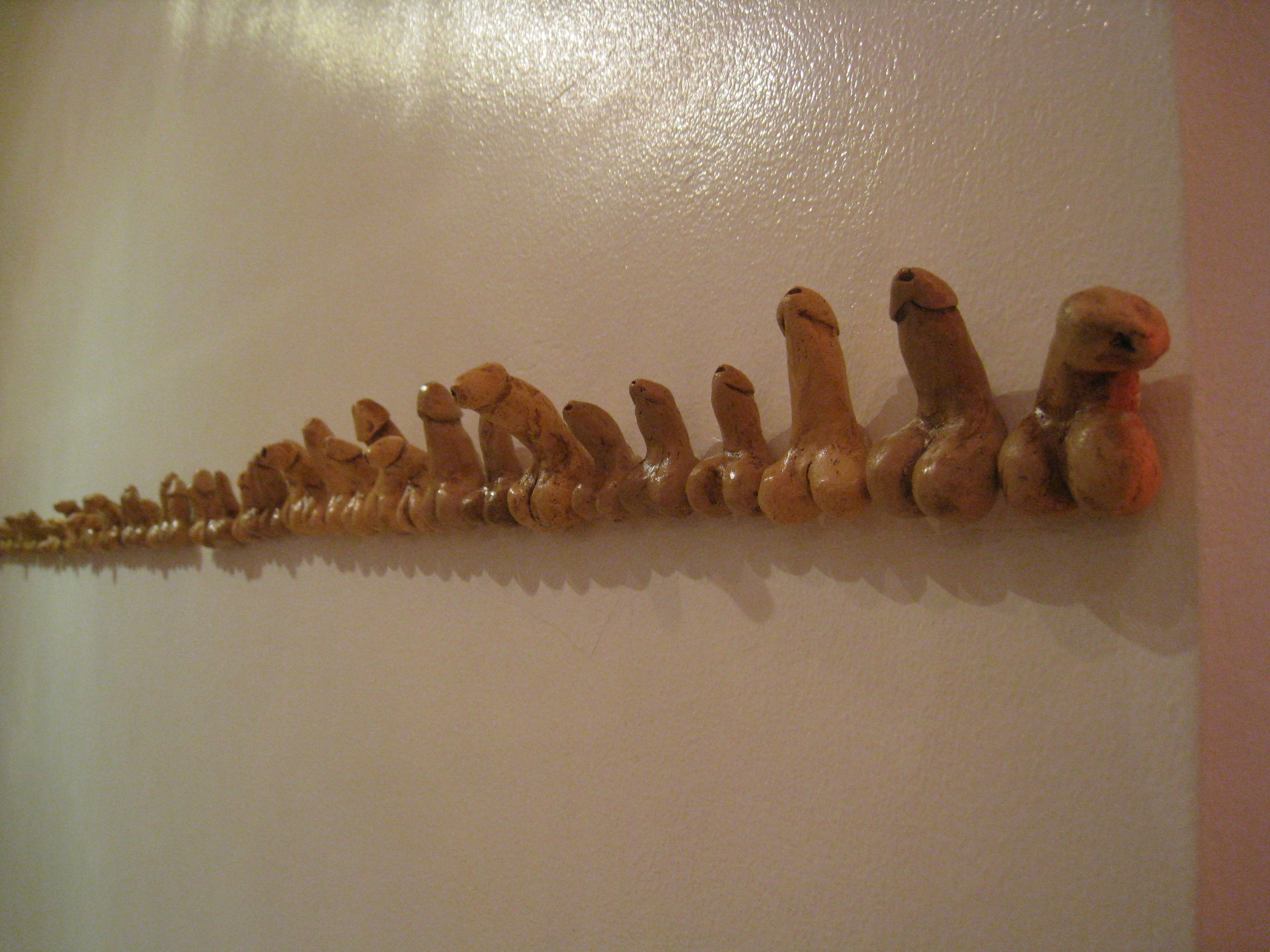
Beside the condoms, Kiri’s Penis Line (After Mommy) forms a single procession along the entire length of the wall. Dozens of thumb-sized terracotta penises appear to wiggle, bow, or stand in attention. One can choose to acquire them singly or in groups. Take your pick!
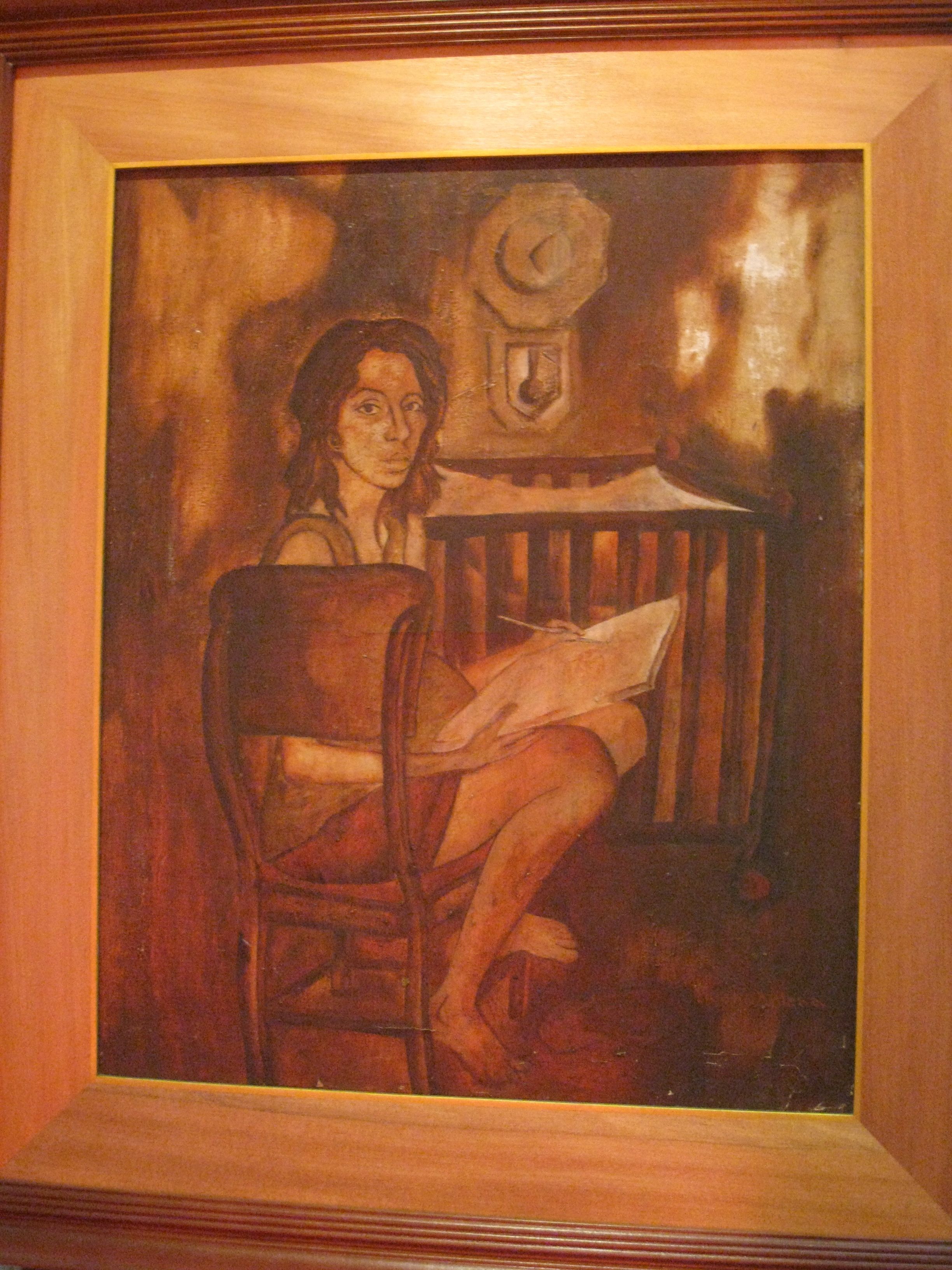
Two self-portraits complete the show. One of them is of Julie, an acrylic painting from 1972. In contrast, Sari represents herself in video, a piece for the 21st century.
Kiri Dalena, "Penis Line (After Mommy)", detail
Home Works runs from 5 to 28 October 2010 at the AFM Total Gallery, Alliance Francaise de Manille, 209 Nicanor Garcia St., (Formerly Reposo St.), Bel Air 2, Makati. Phone (632) 897-7757 or visit http://www.alliance.ph
Kiri Dalena, "Penis Line (After Mommy)", terracotta and acrylic
Julie Lluch, "Self Portrait", acrylic on canvas, 1972
Tony Twigg, "Making Mambo In White", oil on canvas, 137x199 cm.
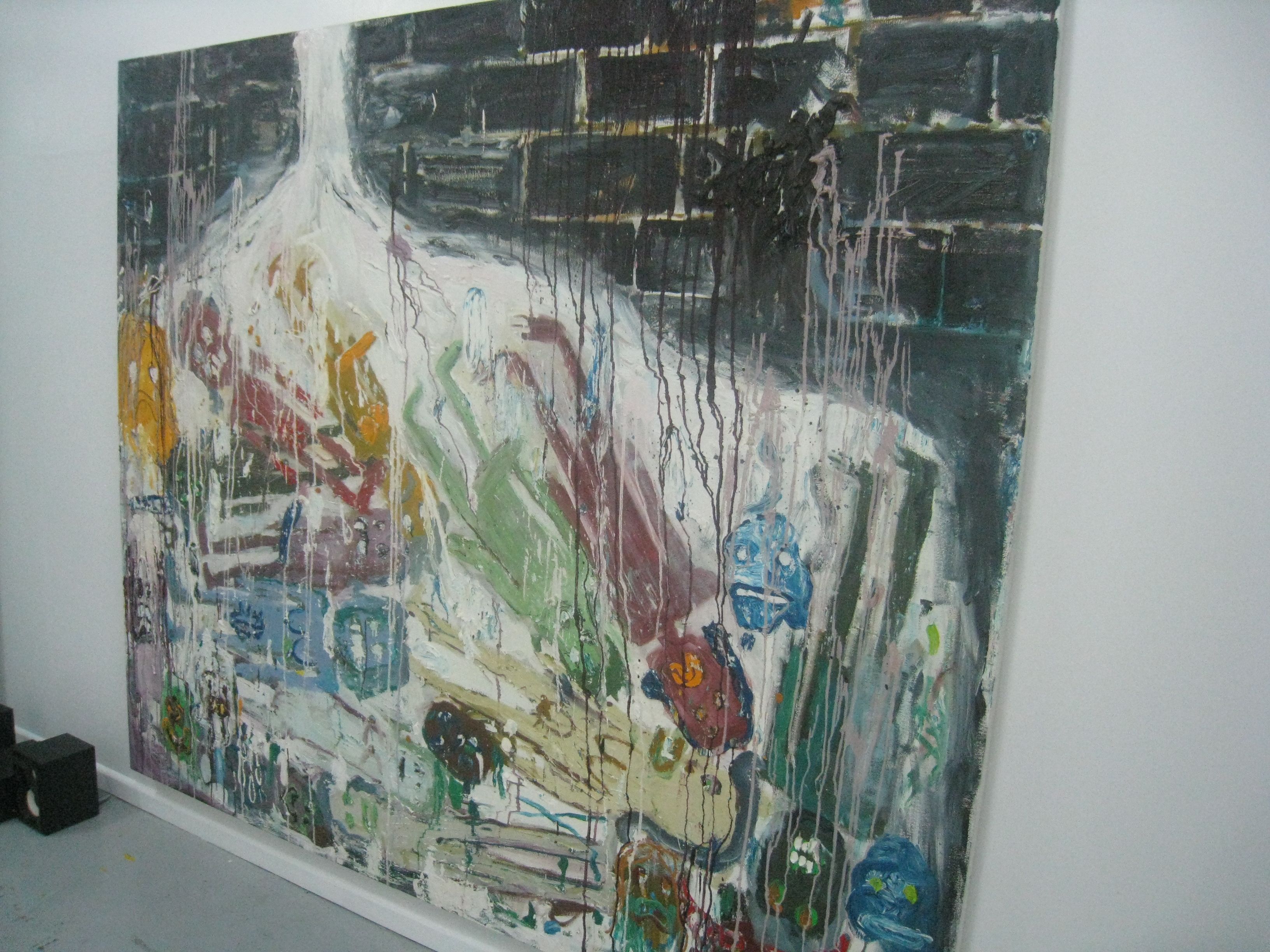
Tony Twigg has not mounted an exhibit of his paintings since his art school days. Art circles in Southeast Asia—the Philippines, Malaysia, Singapore—and in his native Australia, know him for his wonderful wall-bound and freestanding timber constructions. He uses strips of found wood to create abstract patterns that play with positive and negative spaces. He leaves gaps in between these bands of milled wood that do as much to complete each piece as the wooden portions. “Just think of a donut”, Tony explains. “What is important is what is not there.”
Tony Twigg, "The Vibrafon", enamel on timber construction in 16 parts, 120x38406.5 cm
It is these spaces in between that have led him to the new direction his art has taken for The Entropy Shuffle and Other Compositions From The Vibrafon, now on view at Galeria Duemila.
One looks at the exhibit as a visual progression that starts with The Vibrafon, a three-dimensional piece in wood, and ends with Standing Vibrafon, a three-dimensional piece in metal. In between the two points, Tony plays with patterns drawn from The Vibrafon and transforms them into two-dimensional abstract paintings. He used The Vibrafon’s wooden slats as stencils. Paint serves as the medium that highlights these patterns for us. Tony compares his paintings to HR Ocampo’s pieces: contrasting colors fill in the gaps of what had been negative spaces. Munchkins have been made from donut holes.
Tony Twigg, "The Entropy Shuffle No. 4 and 5", oil on canvas, 120 x 305 cm.
For his nine canvases, Tony adopts a palette reminiscent of mid-20th century mod. The variations in black, white, gray, red, dark brown, mustard, and dull blue give off a retro vibe that one finds in movie posters or print ads from the late 1950s to the early 1960s. They have a feel that a 21st century audience can relate to because of the TV series Mad Men. My personal favorites are the simple ones, black and white, or grays with the touch of red. They remind me of the early Luz abstracts and the Luz mural now installed at the CCP.
Tony Twigg, "Standing Vibrafon", milled steel construction, 170 x170 x 6.8 cm.
The titles that Tony has chosen for his paintings, with their musical connotations (mambo, waltz, shuffle), give us the impression that his artistic process mirrors the composition of music. One piece, when rearranged, can yield a range of scores, all equally enjoyable.
Tony Twigg’s works in wood have always been beautiful examples of contemporary abstraction. Now, with the addition of his paintings, and even his foray into metal, they have become even more so.
Tony Twigg, "The Entropy Shuffle #1", oil on canvas 122 x152.5 cm and "The Entropy Shuffle #2", oil and graphite on canvas, 122 x 152.5 cm
The Entropy Shuffle and Other Variations from The Vibrafon runs from 9 October to 2 November 2010 at Galeria Duemila, 210 Loring St., Pasay City. Phone (632)831-9990 or visit http://www.galeriaduemila.com
Tony Twigg, "The Entropy Shuffle #3", oil on canvas, 122 x 152.5 cm
Tony Twigg, "Blue Sky Waltz 5 and 6" (Diptych), oil and enamel on canvas, 244 x 61 cm
Tony Twigg, "Blue Sky Waltz #1 and 2" (Diptych), oil on canvas, 122 x 122 cm
I got lost getting to LOST. I made a wrong turn the first time I dropped in on LOST Projects, Manila’s newest alternative art space. I came two days before the venue formally opened, and the sign outside had still been covered up. The ground floor gallery slash artist’s studio smelled faintly of paint, and its walls dazzled with a fresh white coat. Continue reading →
Luis Lorenzana, "The Summon of Emperor Fragile with the Green Yuki Girls", 48"x36, oil on canvas
Luis Lorenzana’s personal journey as an artist can rival his paintings’ fantastic elements. The Tales of The Beer Fairies, now running at SLab, takes us to Luis’s fanciful woodlands. Here, trippy beer bottles flutter around, getting drunk on the emotions of humans who wonder within their proximity. The paintings take the point of view of the fairies. Through their eyes, humans themselves appear like enchanted creatures— with soulful eyes and clown faces, possessing two heads, and levitating through fields of green. Continue reading →
Don Salubayba takes on the role of storyteller in Lamat, his one-man exhibit now on view at Tin-Aw Art Gallery. He
Don Salubayba, "Pinag-uugatan", mixed media on wood, 12"x24"
turns to his inclinations as an animator, honed through his involvement with the Anino Shadowplay Collective, in this attempt to bring to life a legend on the origin of the Philippines. Continue reading →
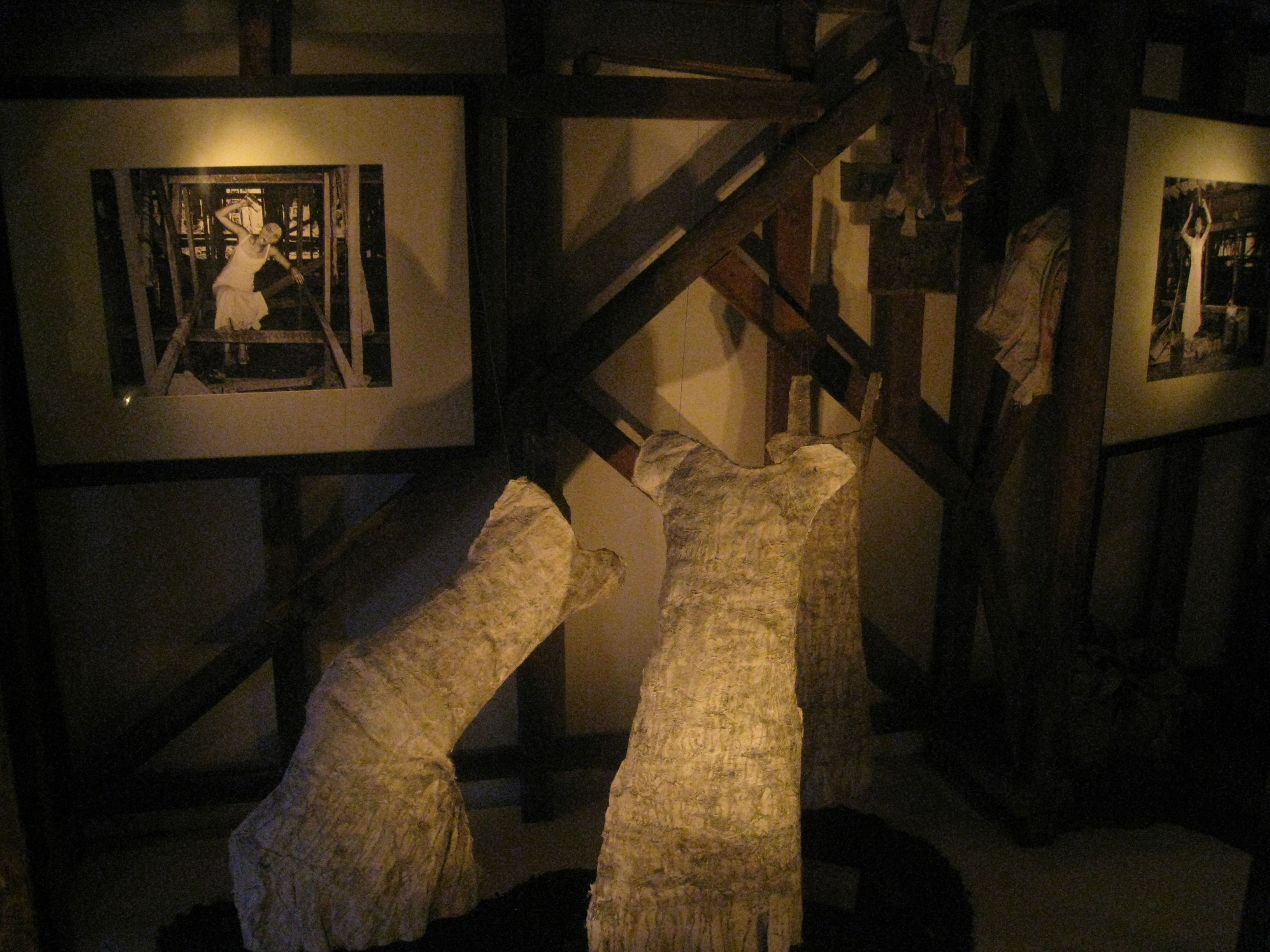
When cross-disciplinary artist Maxine Syjuco started conceptualizing her piece, She May After Drinking You Sink Quickly Or
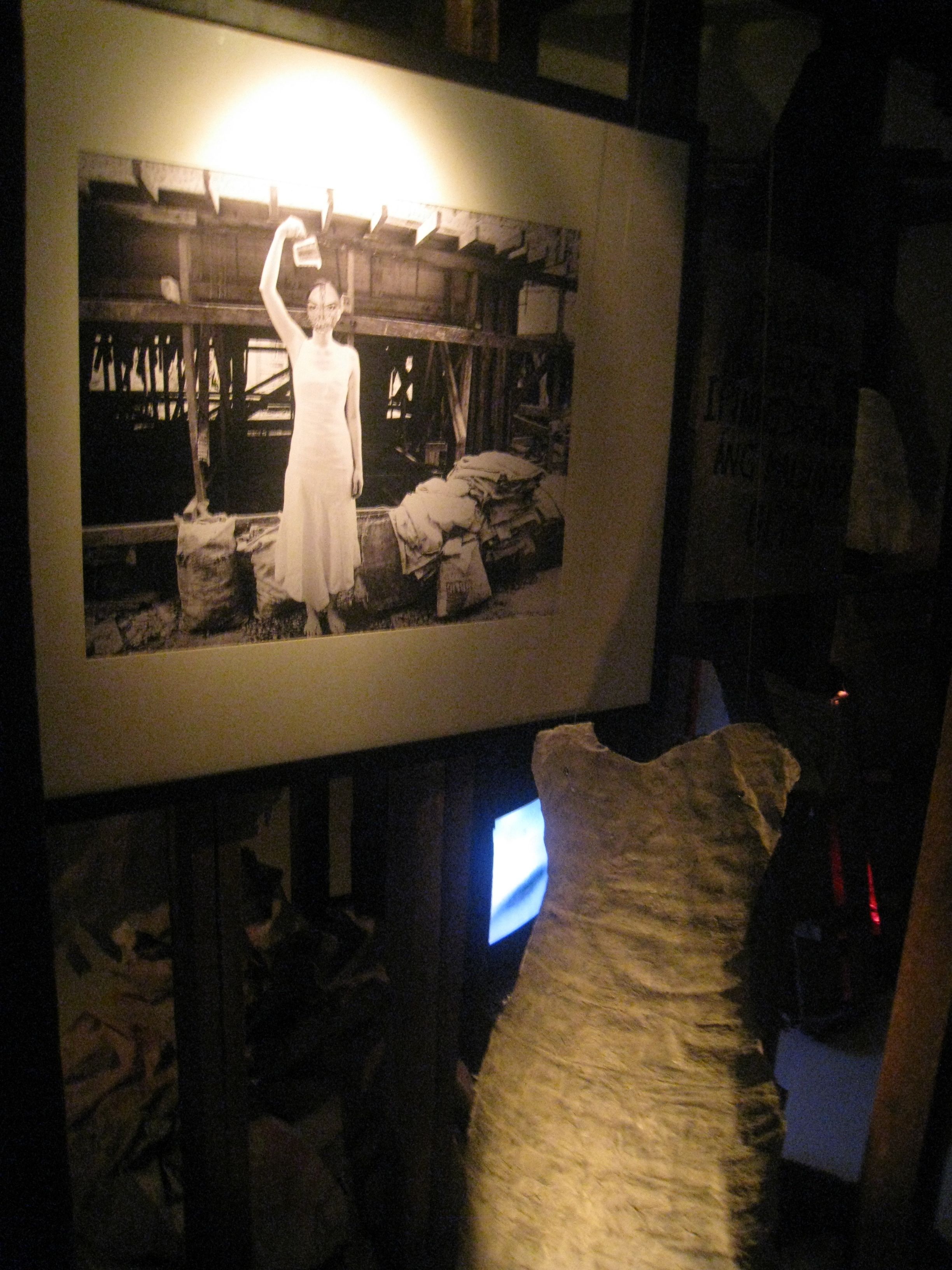
Maxine Syjuco, performance photo collage and papier mache dress from her installation, " She May After Drinking You Sink Quickly And Drown"
Drown, she shuttled between two construction sites. Outside her bedroom window she would track the progress, and hear the inevitable noises, that came with building a small structure, one that would eventually house a studio for her parents, artists Cesare and Jean Marie Syjuco. At the same time, the space that had been earmarked for her work, what had just been designated as the new gallery space of The Picasso Boutique Serviced Residences, was also in the process of being refitted. It would open just in time for the Syjuco family’s exhibit at the hotel.
By Maxine Syjuco
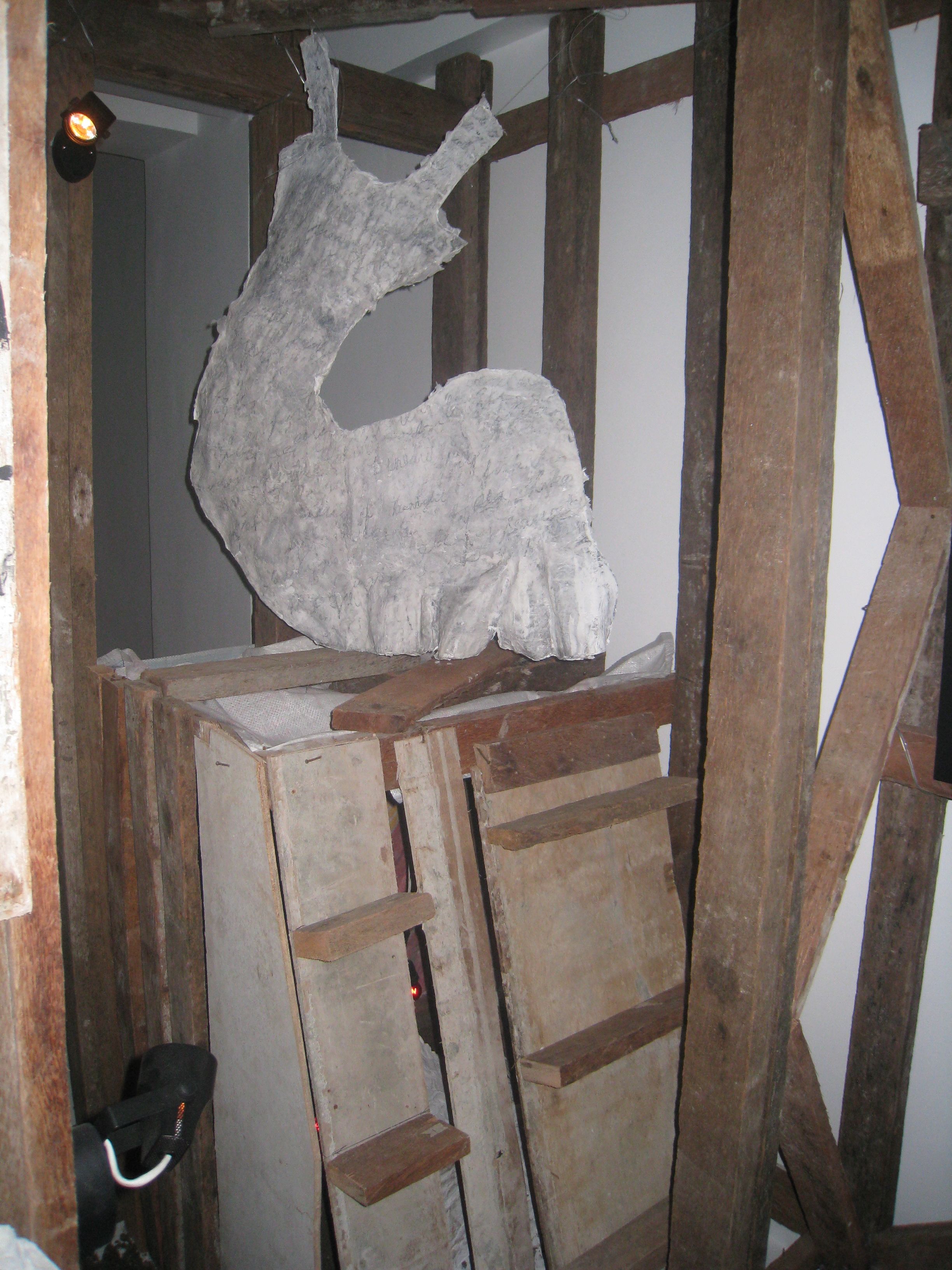
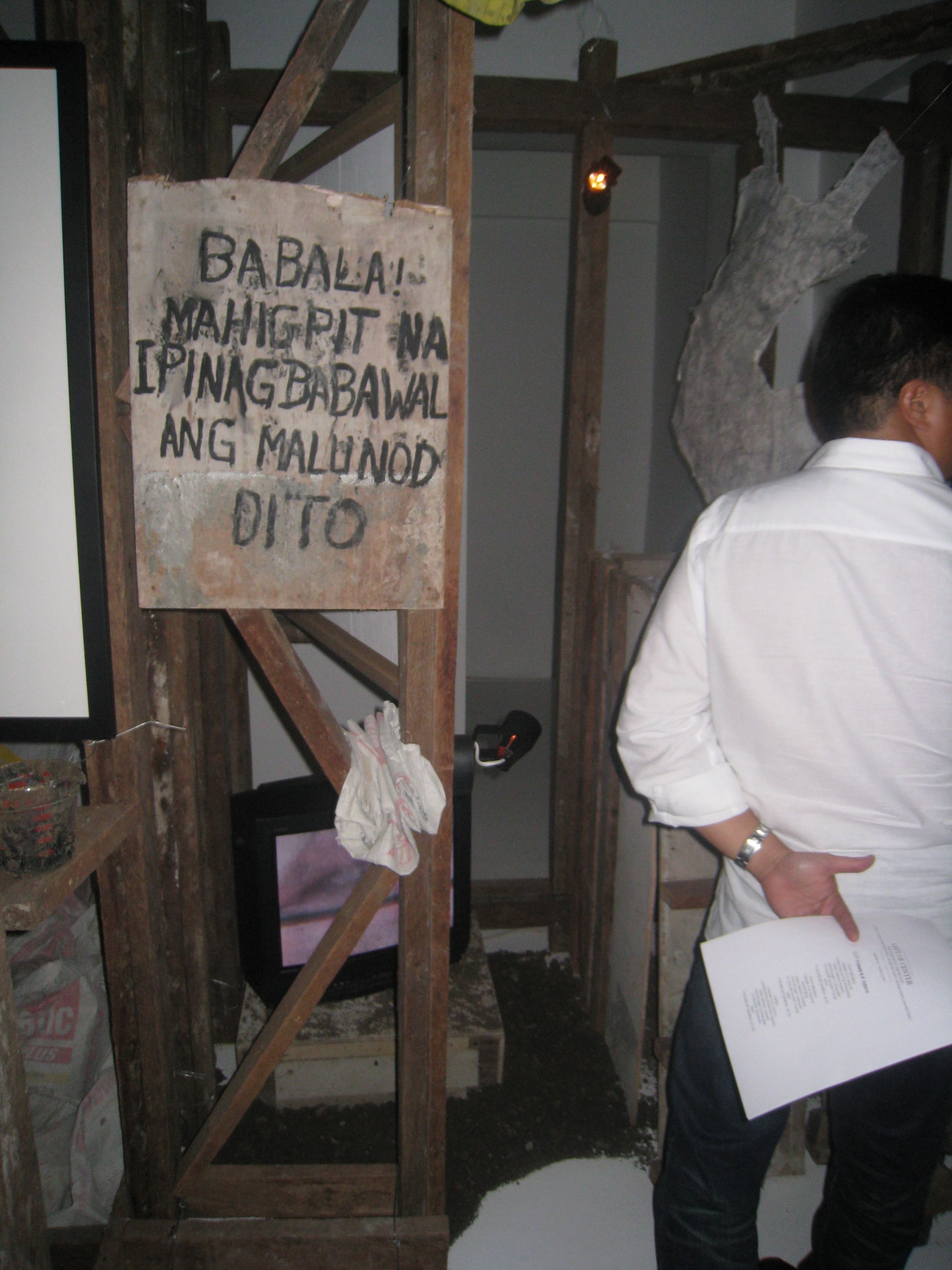
Maxine’s installation recreates the construction site of her parents’ studio inside the newly opened gallery. She uses it as remembrance to both what the gallery space had just gone through, and what had been a constant presence in the vicinity of her personal space. She recycles materials salvaged from the site in her home and transforms them, thereby reflecting and continuing the creative process that went on before in both places.
Waste materials have been given new life: the coco-timber used for the studio’s scaffolding has been reused here; they form
By Maxine Syjuco
the structure that anchors the entire piece. Maxine fabricated long and flowy dresses from the paper sacks that had contained gravel and cement. She finishes these dresses by scribbling lines from her poems that she had previously
By Maxine Syjuco
rejected as not being good enough.
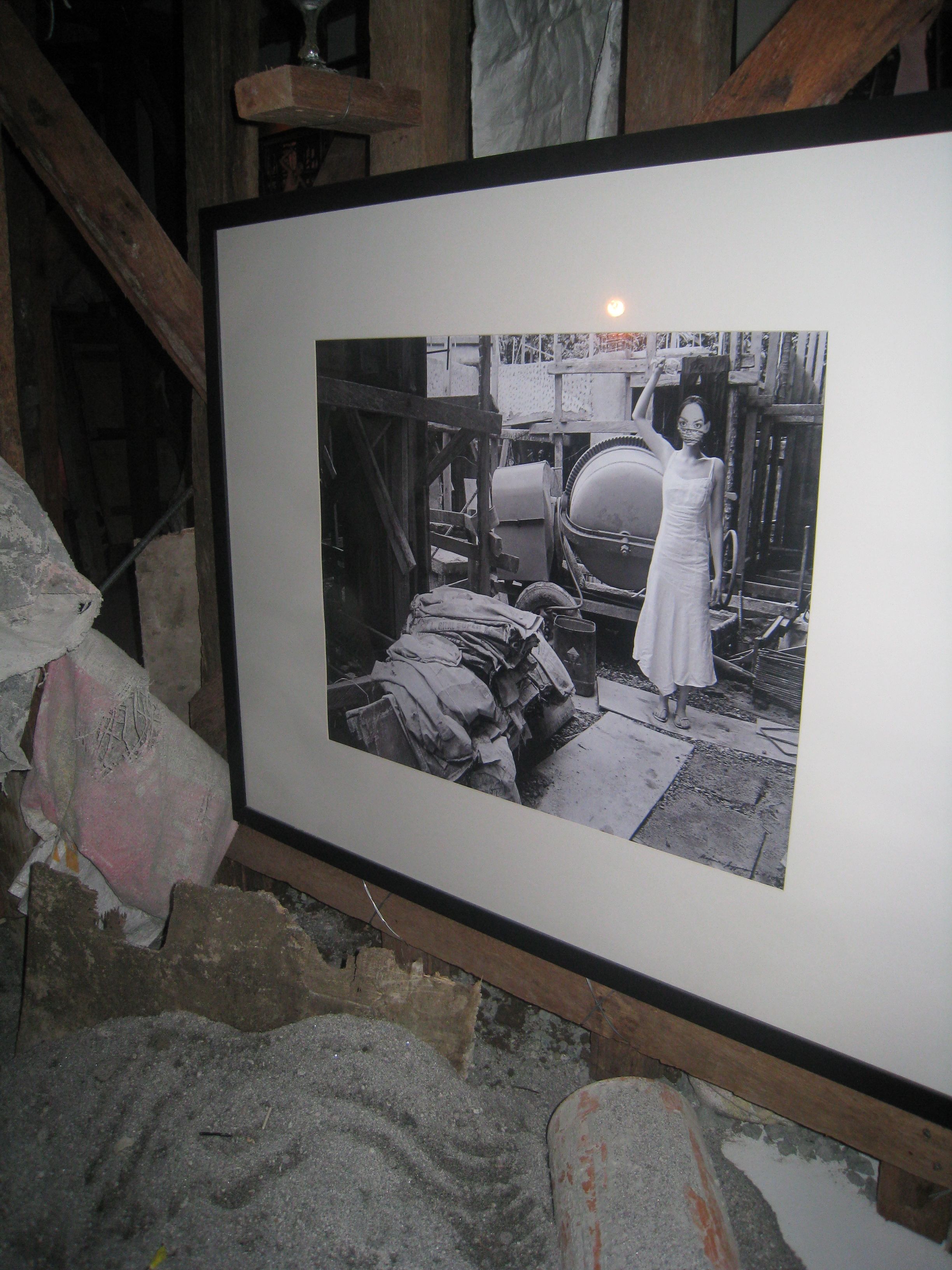
Maxine hangs several photographs within her interactive piece. She describes these black and white pieces as recycled artworks. To put them together, she started off with old photographs of her performance pieces salvaged from albums that had been damaged by flood. She took new photos of these damaged photos, and then superimposed them on new photographs taken of the construction site. It is from these images of herself that the patterns of the papier mache dresses have been taken from.
Photo collage from Maxine Syjuco
The title of this installation echoes the process that these photographs had gone through. Previously drowned photos have been drowned again in the process of redeveloping them.
Maxine’s artist statement injects a tribute to the overseas worker within the piece. I thought that added unnecessary complexity to a piece that already contains so much food for thought. On its own, it already delivers a visual punch.
Inside Maxine Syjuco's installation
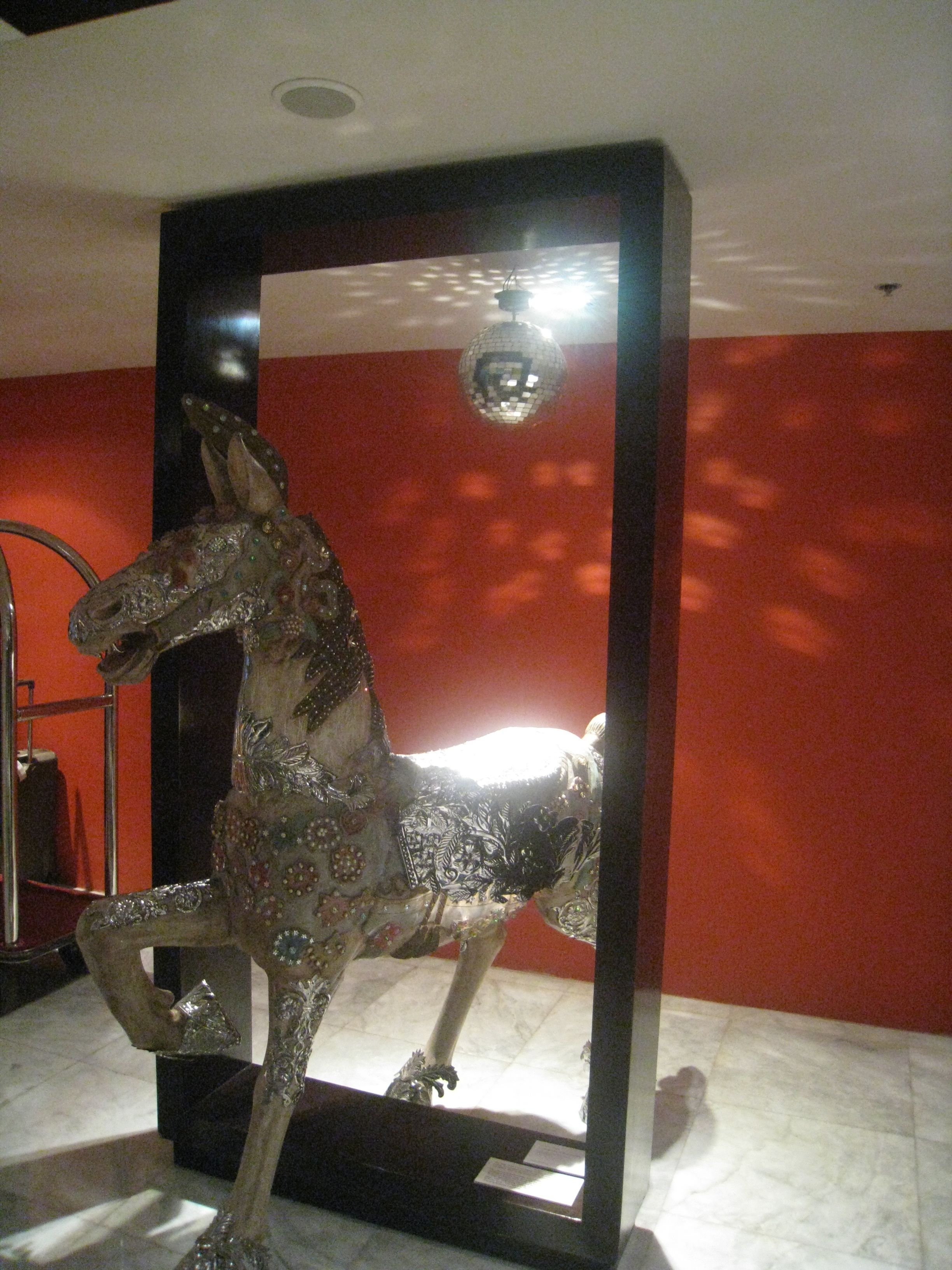
The Syjuco family exhibit, Left of Center, is spread out over all the public areas of the hotel. The photo collages of patriarch Cesare, with its hilarious lines and witty images, grace the hotel’s entrance and lobby, as well as the elevator lobbies of all floors. Jean Marie has an installation piece at the lounge area. Also at the main lobby, by the elevators, Michelline Syjuco resurrects her embellished wooden horse from the 2009 Sungduan exhibit at the National Museum. It is her commentary on globalization as a Trojan horse for developing countries. Trixie’s (Beatrix) video plays on the second floor lobby’s main wall.
Maxine and Michelline Syjuco
While Maxine’s piece is undoubtedly the major work in this exhibit, you can’t help but imbibe the creative energy of this talented family. They often work together, and it shows in how their pieces gel. Their household must be so much fun!
At the main lobby, Cesare AX Syjuco, "Weird Birds"
Left Of Center with Cesare A.X. Syjuco, Jean Marie Syjuco, Michelline Syjuco, Maxine Syjuco, and Beatrix Syjuco runs from 24 September to 24 October 2010 at The Picasso Boutique Serviced Residences, 119 LP Leviste St., Makati City, Philippines. Phone (632) 828-4774 or visit http://www.picassomakati.com or http://www.artcabinetphilippines.com
Michelline Syjuco, "Globalization: A Trojan Horse"
Lena Cobangbang, "A Thousand, A Thousand, A Thousand...(Schema After Rilke)"
The appeal of Lena Cobangbang’s show, Velvet Landings, now on its last few days at MO Space in Bonifacio High Street, comes from its quirkiness. What strikes me as various tableaux lie spread out over the gallery’s main space, each scene set atop a rectangular light brown carpet. They all possess the appearance of grade school art projects—raw and handmade, the antithesis of the slick and sleek industrial pieces produced in the workshops of say, Damien Hirst and Jeff Koons. You see the humor in the construction of Lena’s pieces, in her use of
Lena Cobangbang, "A Cloud That's Flat of Angles"
accessible materials, readily available from National Bookstore.
What does not become apparent until you read the notes provided by the gallery is that they pertain to landings. Sort of. A Thousand, A Thousand, A Thousand…(Schema After Rilke) takes inspiration from the poem by Rainer MariaRilke that describes a panther trapped in a cage. Lena has camouflaged a stuffed panther in orange and green felt strips, cut to simulate grass. When ready to pounce, a panther lands quick and quiet on its feet.
Lena Cobangbang, "The Speed of the Last Clap"
A lightning bolt strikes down a floppy harlequin in The Speed Of The Last Clap, metaphor for a joke that falls flat. In A Cloud That’s Flat Of Angles, you see the figure of a beast scorched on the carpet, as if it had been squashed and has left its imprint.
I can’t pretend to understand all of Lena’s work. I don’t really know how the colored felt strips (the same ones used to cover the panther) scattered to spell out “Pantera” in The Art Of Shredding fits in. Or even Woolwood, where she rolled up one of the
Lena Cobangbang, "The Art of Sh/r/edding"
carpets to simulate a felled log with a small growth of greens. For RavishingColossus, installed inside the gallery’s small room, she worked with wax drips to put together a group of cone shapes that mimicked snowcapped mountains; they emit a neon glow when hit by black lights.
Lena Cobangbang, "Revising Colossus"
I first saw Lena’s work two years ago at the 2008 Singapore Biennale (See this blog’s archives, October 2008). TerribleLandscapes documented through photographs her recreations of disaster areas using food. Even then she had built miniature tableaux using everyday materials in a most unexpected manner: parsley sprigs turned into foliage, slices of blue cheese stood in for wrecked homes. Just as it was for those pieces, what registers with Lena’s newest work is her departure from the usual art exhibit offerings—kooky, but definitely not boring.
Lena Cobangbang, "Woolwood"
Velvet Landings runs until 26 September 2010 at MOs Space, Bonifacio High Street, Taguig. Phone (632) 856-2748 or visit http://www.mo-space.net
On some days, Troy Ignacio sits on a park bench at the center of Makati, an unobtrusive observer of the people around him . He
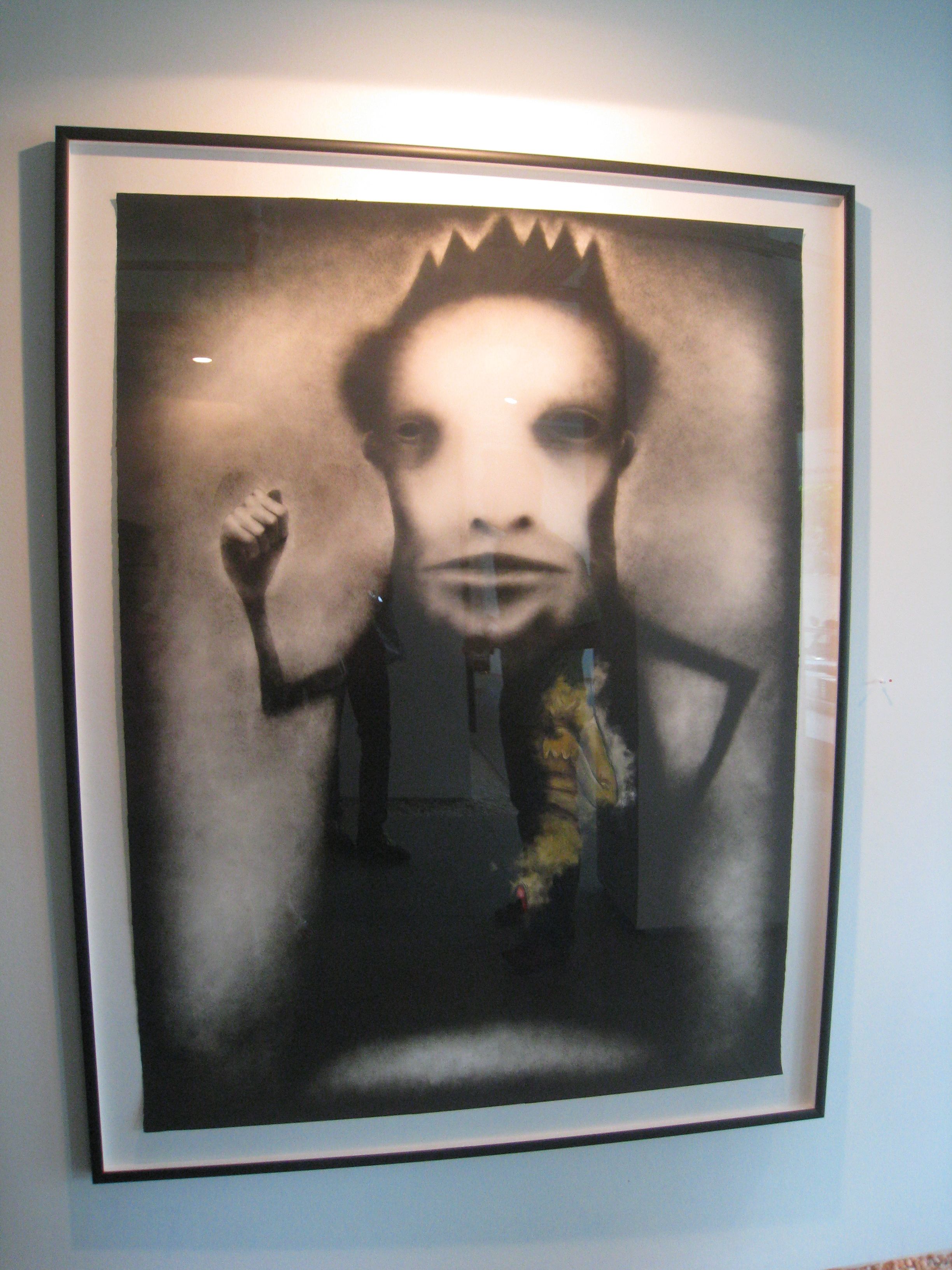
Troy Ignacio, "Da King", oil on paper, 5ft x 4ft
quietly sketches what he sees. It could be the working stiff laughing loudly at some unknown joke or a lady scurrying to complete an errand. Like all kibitzers, he wonders at the stories that each person carries beneath their visages. What secrets do their frames contain? Continue reading →
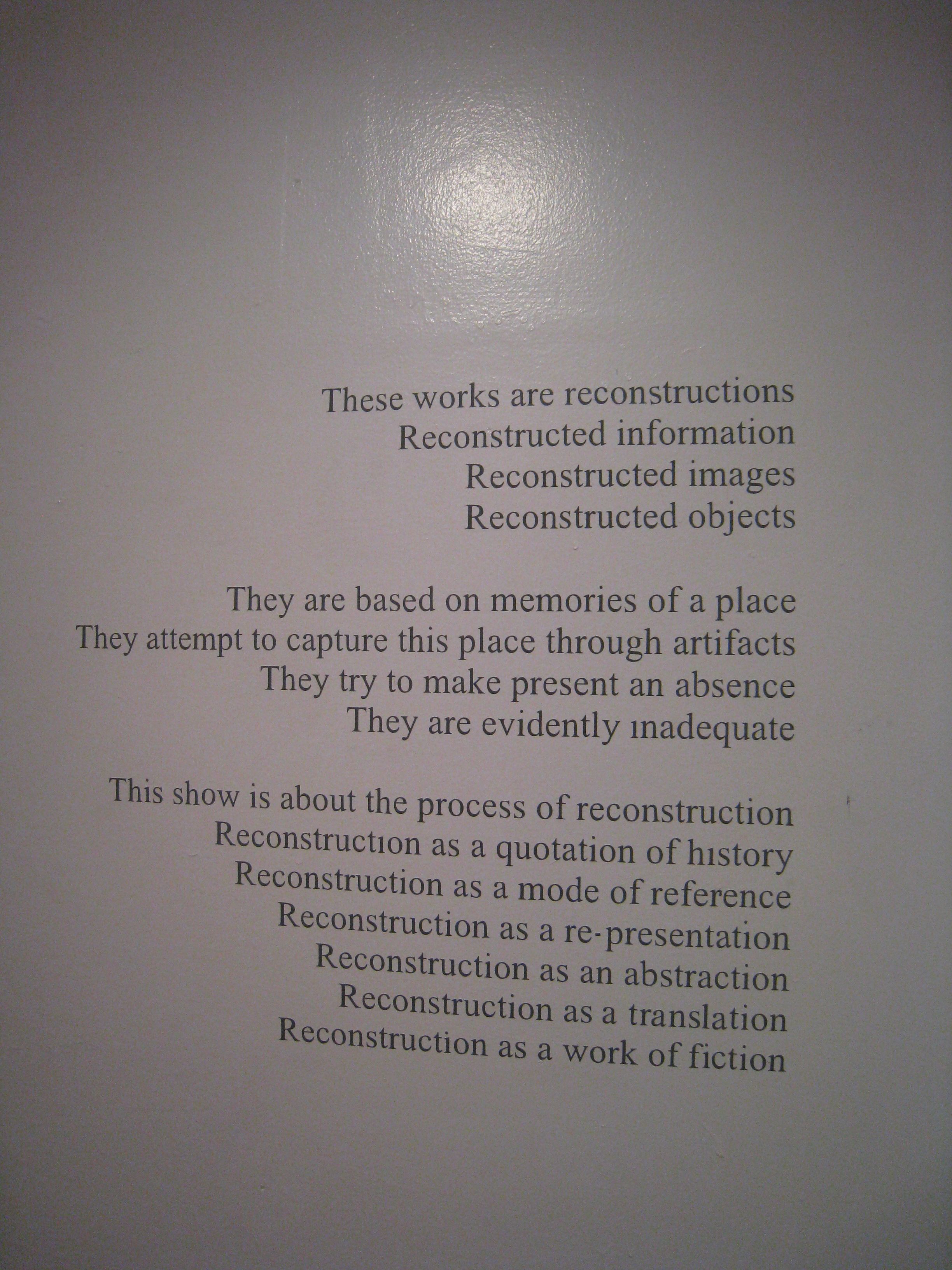
Predictably, Bea Camacho mounts a spare, austere show at Pablo. With Standard Fiction, as she has done before, she trims off the fat and fluff, leaving the viewer with work that’s picked clean, sans whimsy, but full of content and meaning. Bea’s work frequently culls from her family’s story, but told bereft of sentiment and emotion. She reduces life-changing events to clinical, antiseptic, measurable units—blocks on a graph, or indentations on paper. Here she attempts to recapture memories and impressions of their family home as it undergoes demolition and renovation. Bea presents us with the idea that once an object is destructed, attempts to reassemble it will result in another object, not what it originally was. Reconstruction does not give us back what we lost, but rather something else altogether.
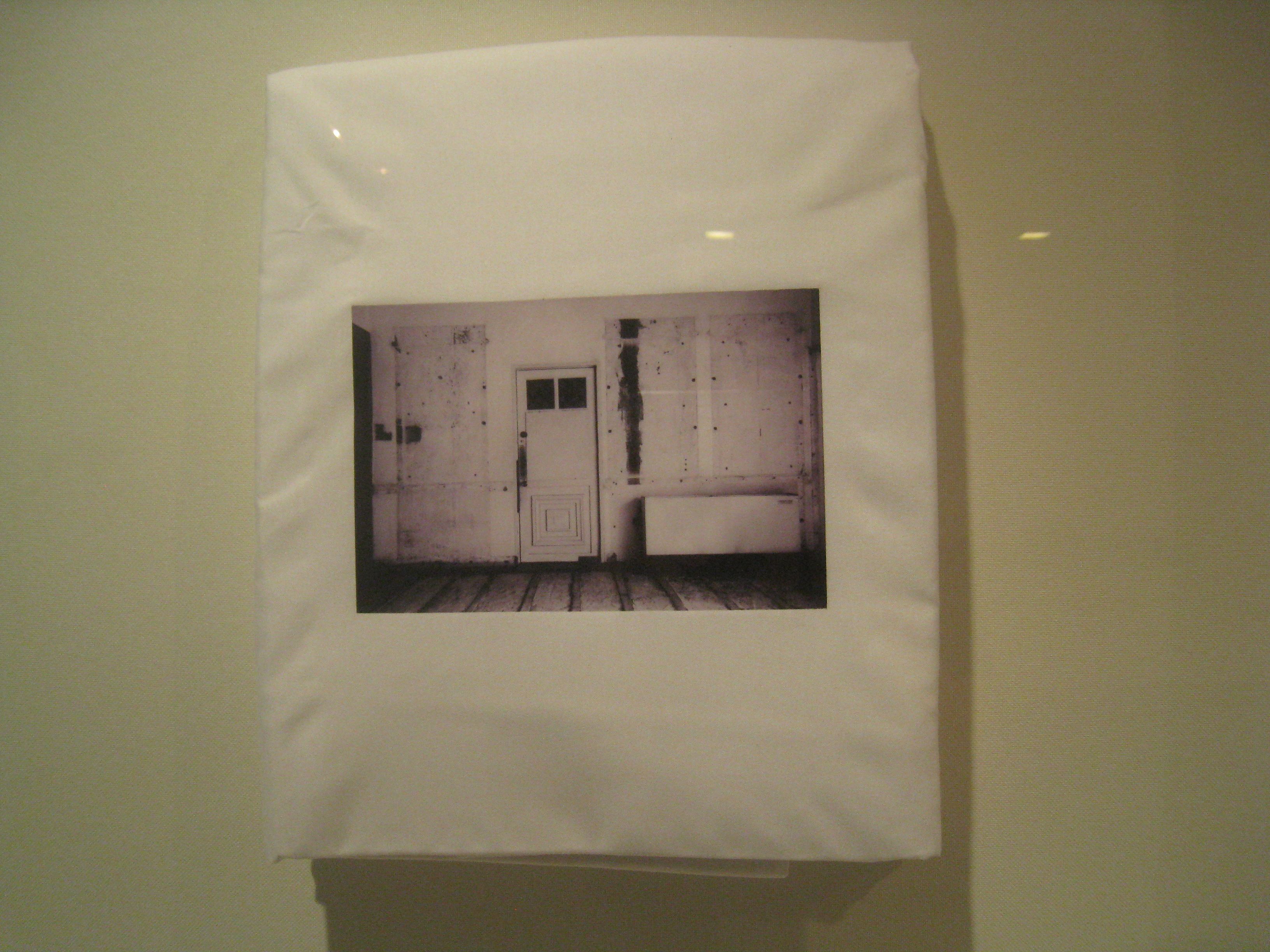
Bea Camcho reconstructs a room, photo transfer on folded bedsheet
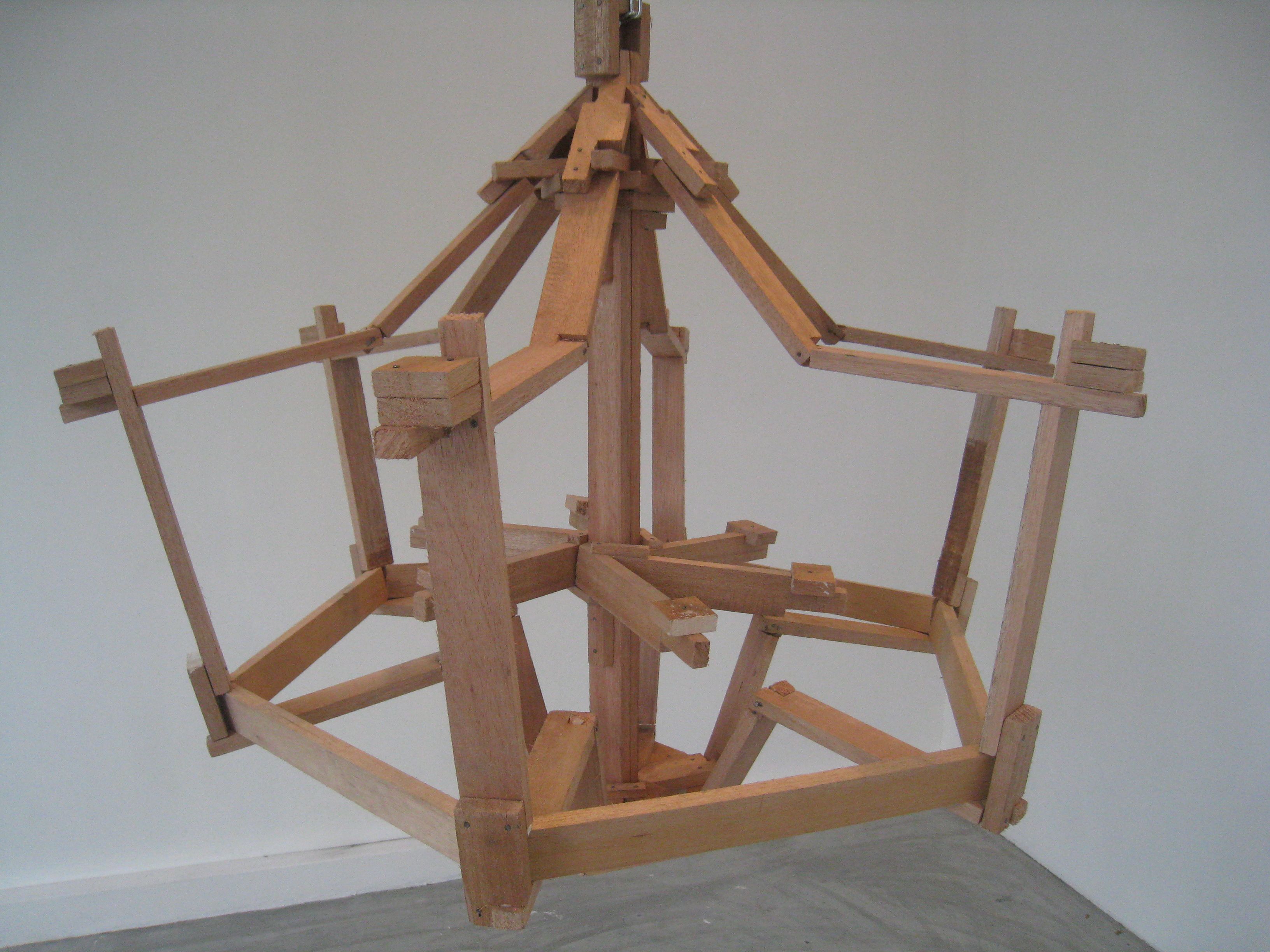
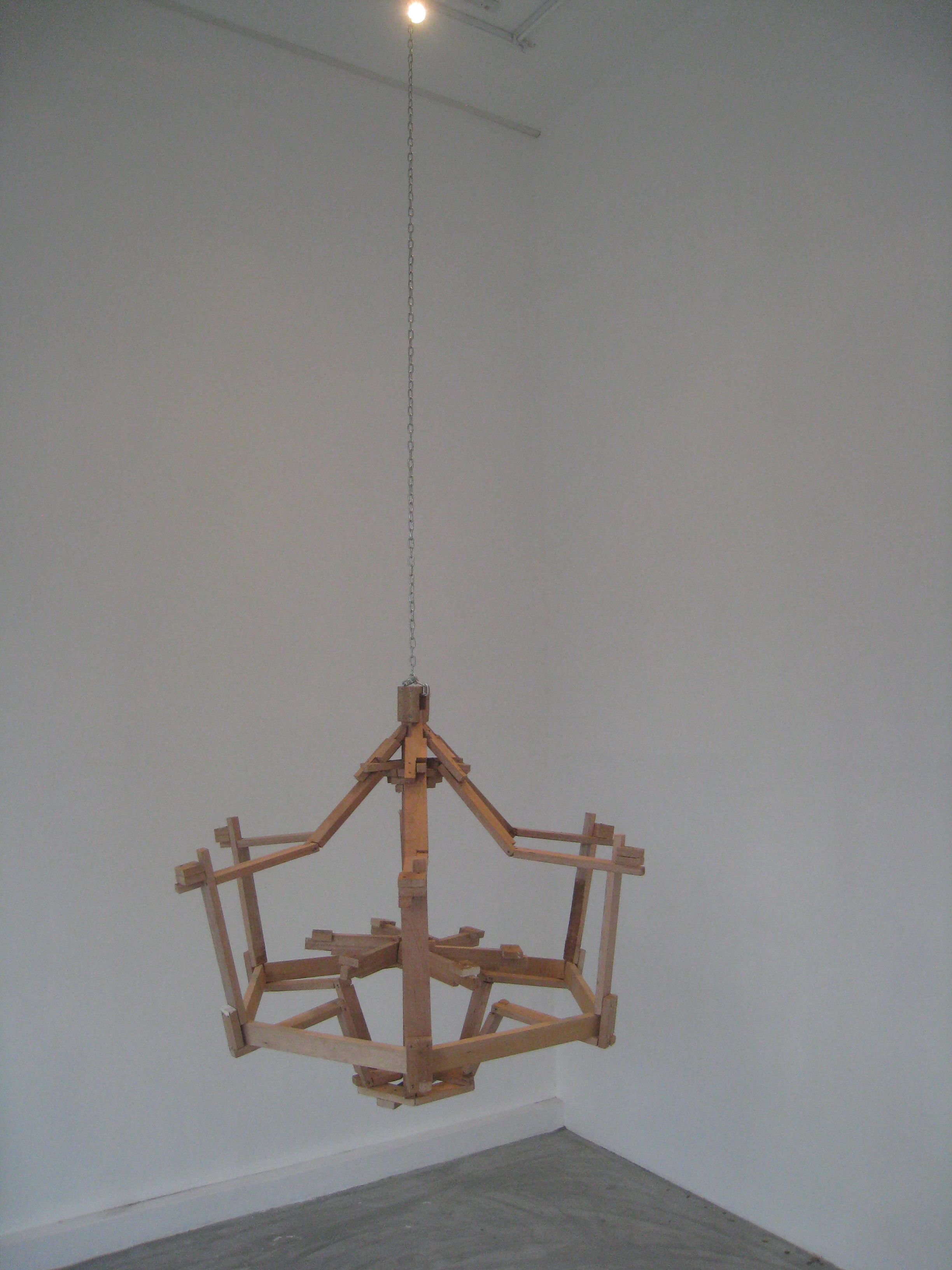
As we enter Pablo, we are confronted with a clumsy, wooden chandelier hanging in the middle of the space. This is the first of Bea’s reconstructions, an attempt to bring back some form of the light fixture that used to grace their home. By choosing to remember it in another material, she leaves us with its crude facsimile.
In the gallery’s loft, she fills the walls with more reconstructions. Bea
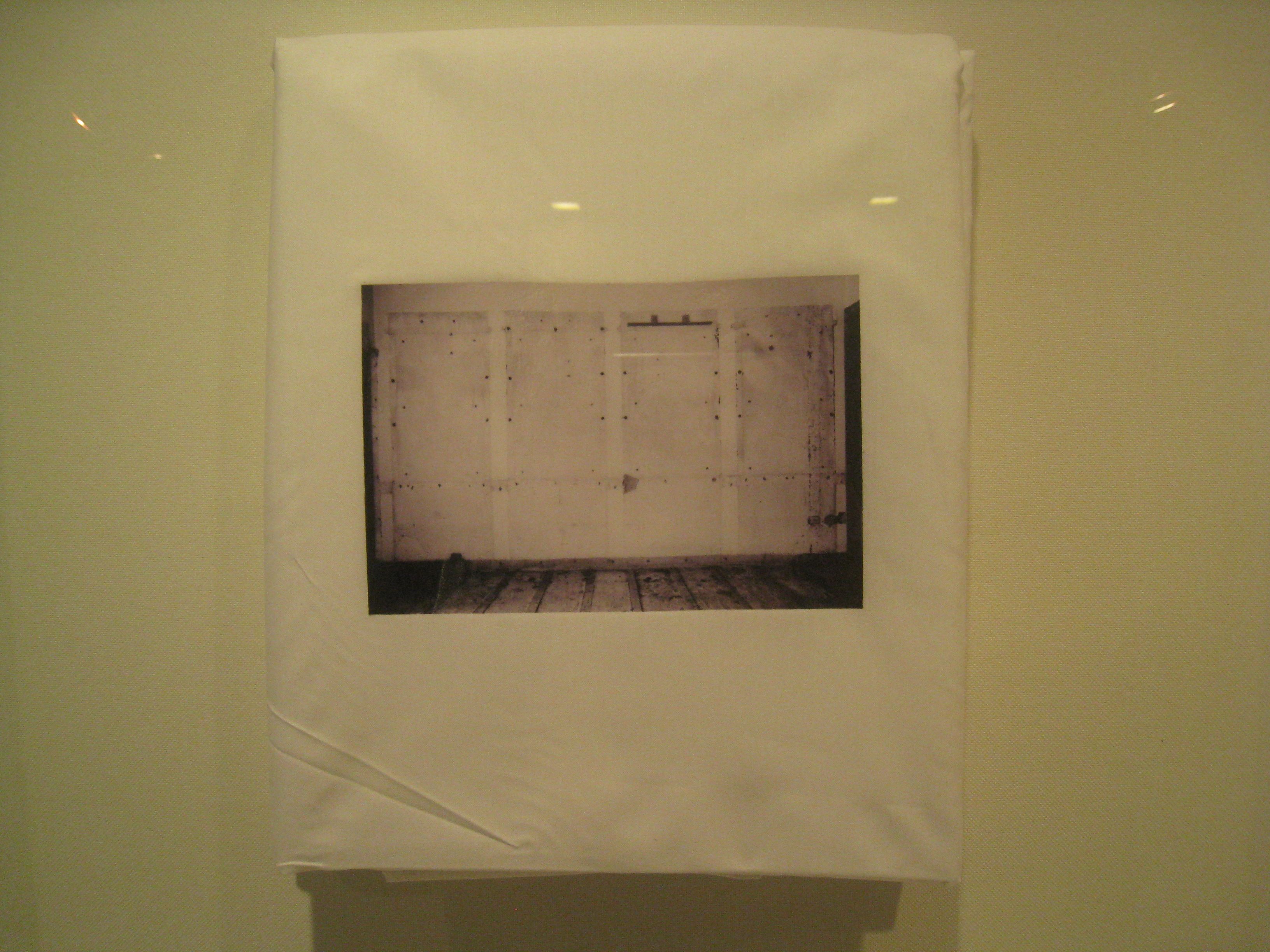
Another attempt to reconstruct a room, photo transfer on folded bedsheet
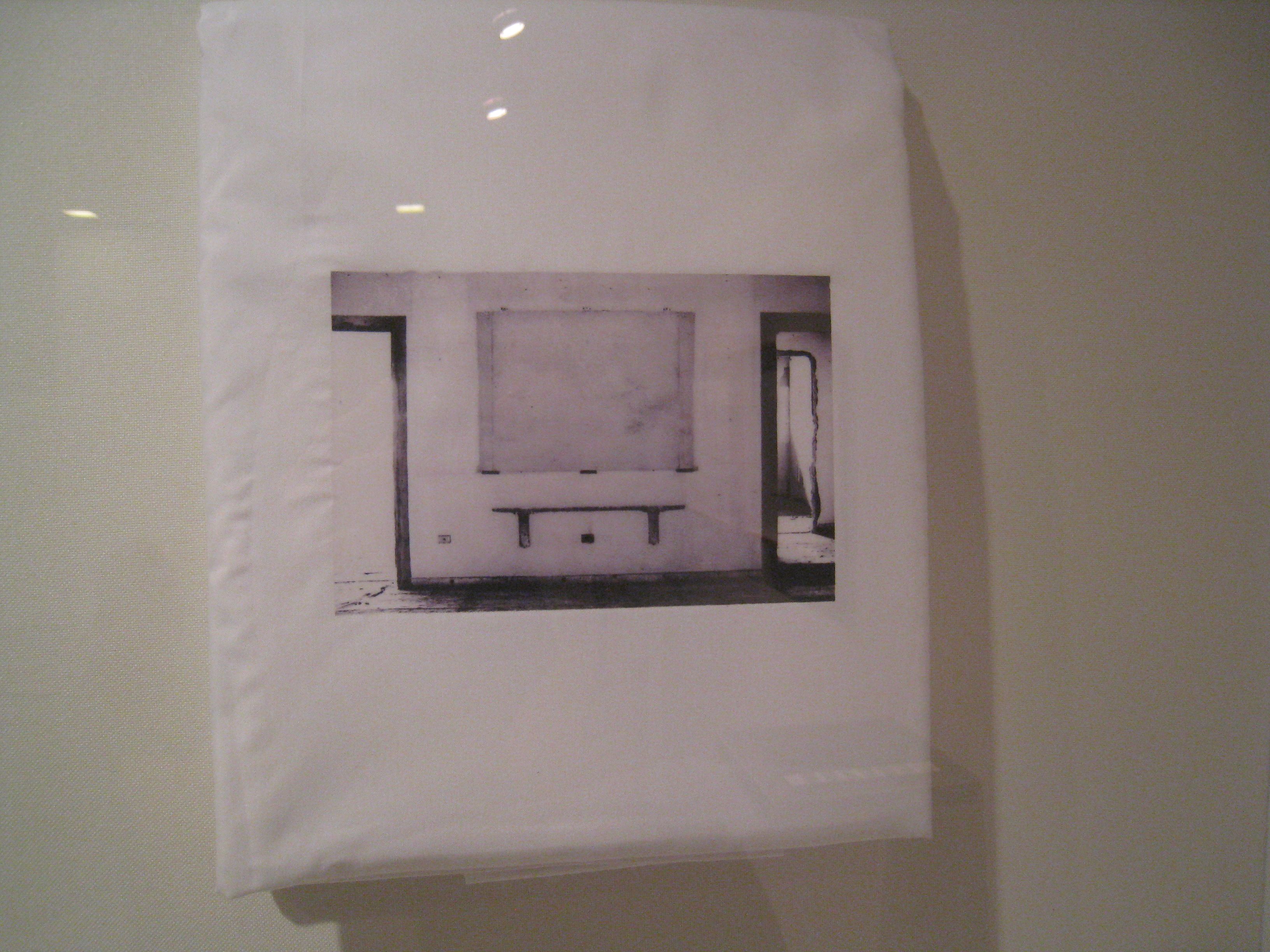
transfers four photographs of empty rooms onto crisp, white bedsheets. The sheets have been folded and encased beneath glass. The photos show four rooms stripped bare, even the fixtures that once had been nailed to its walls have been torn down. The photos capture their outlines, mere traces of the originals.
Another photo transfer on a folded bed sheet
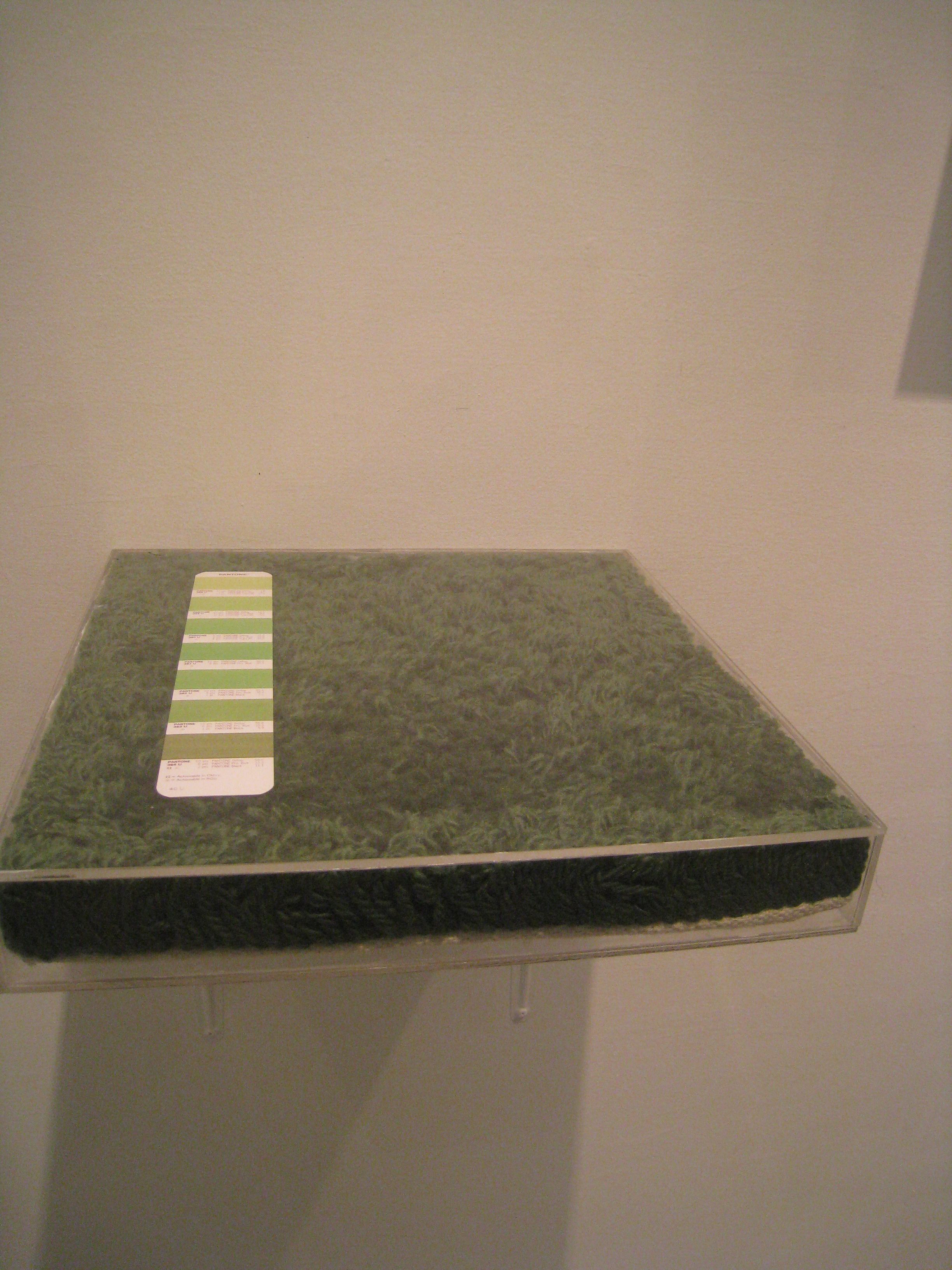
Bea underscores the impossibility of exact reconstructions in her attempt to reproduce a carpet that lingers in her memory. She encases a forest green swatch along with a strip from a photocopied Pantone guide. Because a cheap photocopy from a sidewalk copier fails to translate the color faithfully, the carpet cannot be cloned. None of the presented shades of green capture its color.
Recontstructing a carpet from memory
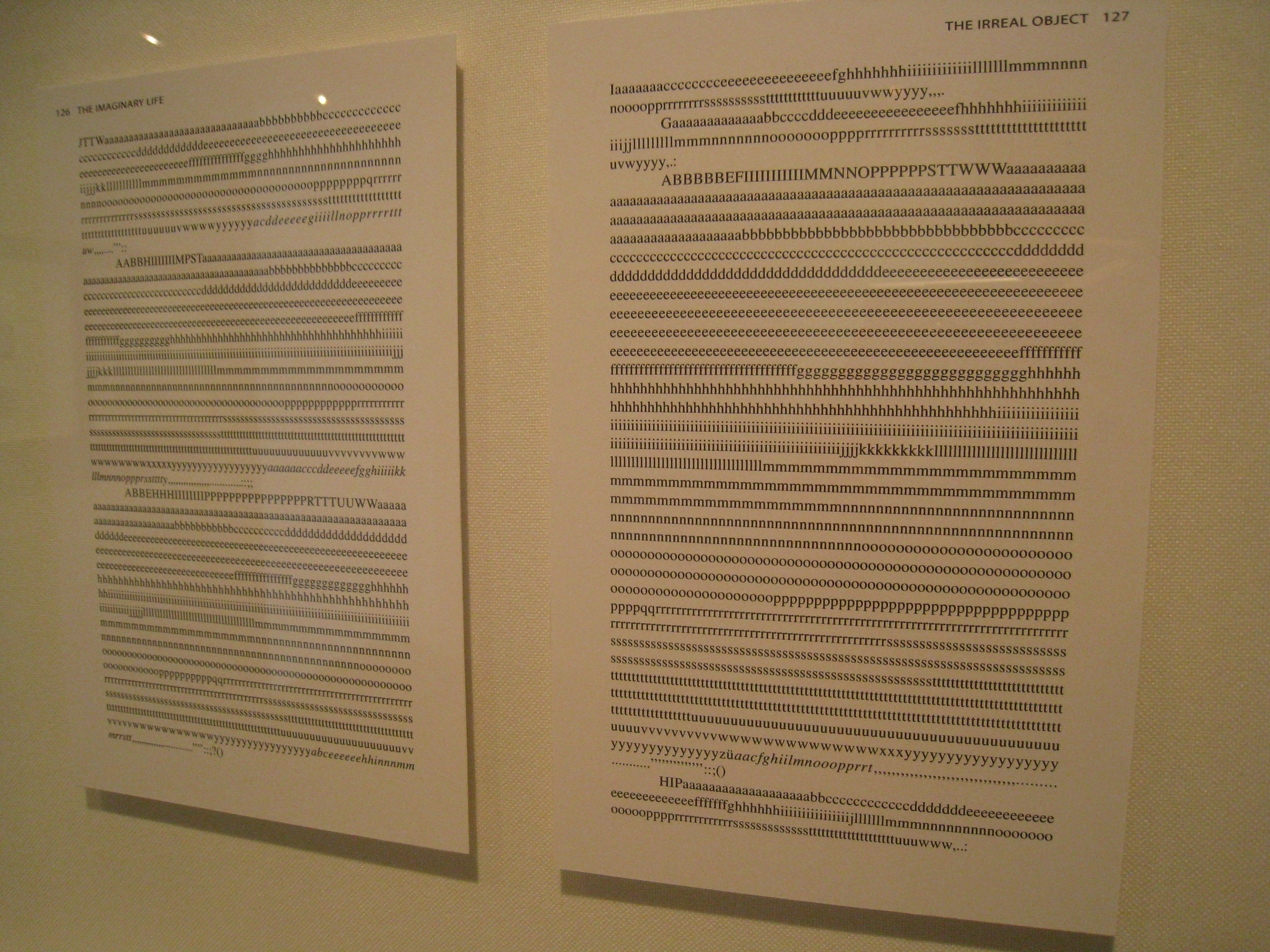
Next to this, Bea hangs two framed works, each holding two typed up sheets of paper formatted like pages from a book. . These show Bea’s attempts to reconstruct pages 126-127 and 128-129 of Jean-Paul Sartre’s novel, The Imaginary based, I surmise, on some mnemonic code. This yields, inevitably, to gibberish.
Reconstructing Sartre
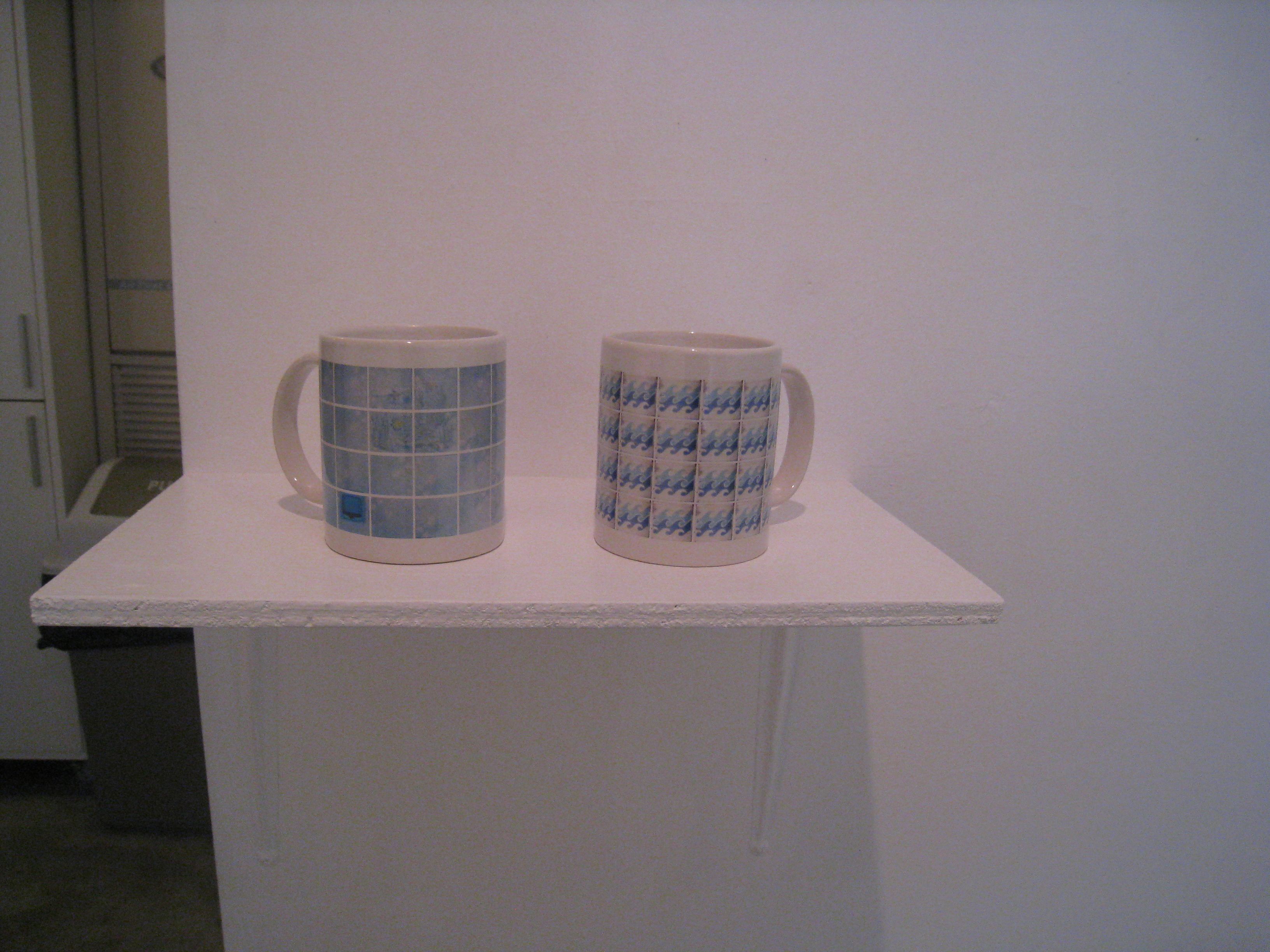
It can be argued that in today’s high-tech world of instants, Bea’s premises fall flat, especially when used for inanimate objects. What she actually examines is the concept of reconstruction as transformation. The two white ceramic mugs, perched almost unnoticed on the gallery’s narrow wall, show this best. The mugs each sport a pattern taken from bathroom and swimming pool tiles from the family home. Bea produced the mugs in the same material as the tiles (ceramic), mimicking, to a certain degree, their original function (as receptacles of water). However, they have been resurrected—totally transformed— into completely different objects. Memory and imagination have interfered with the process of re-creation. Fact has been reconstructed into fiction.
Transforming tile patterns into coffee mugs
Standard Fiction runs from 28 August to 9 October 2010 at Pablo Fort, Unit C-11 South of Market Condominium, Fort Bonifacio Global City, (632)506-0602 or visit http://www.pablogalleries.com